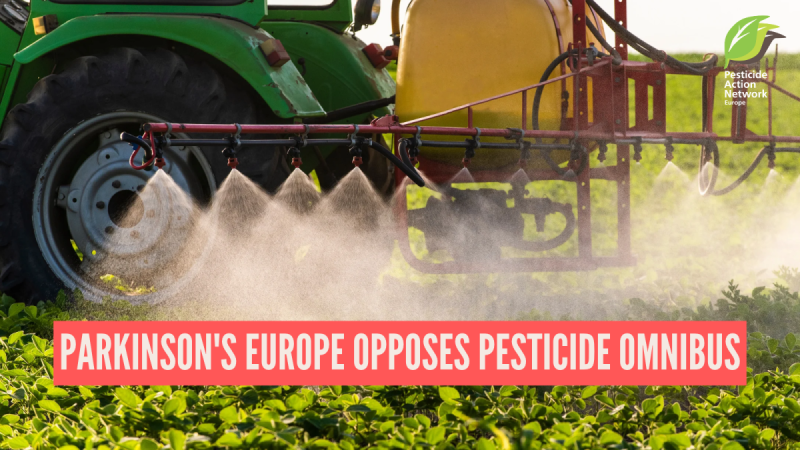
Parkinson's Europe has called for periodic safety checks on pesticides to be maintained. The European umbrella organisation sent a letter to policy-makers to reject the deregulating Food and Feed Omnibus proposal, a "dangerous step backwards for European public health.” Exposure to pesticides is linked to an increased risk of developing Parkinson's, the fastest-growing neurological disease in the world, in particular among the farming community. By dismantling these safety reviews, the Omnibus proposal would remove a key tool for protecting citizens, specially farmers and people in rural communities, the organisation warns.
In a position paper sent to the European Parliament and the Council (Members States), Parkinson's Europe calls for preserving the mandatory, periodic scientific reassessment of substances used in pesticides. The Omnibus proposal would replace these periodic reviews with unlimited approval periods and theoretic ad-hoc reviews. This means "approved pesticides will be deemed safe indefinitely unless proven otherwise, violating the precautionary principle and removing any incentive for the chemical industry to reassess its products as new science emerges."
"Such a system cannot safeguard human health as effectively as the current periodic framework. The EU must retain its leadership in high environmental and health standards. Parkinson's Europe urges policymakers to reject the proposal accordingly”, the organisation concludes.
High costs for the European health system
Every year, more people are diagnosed with Parkinson's, at an ever younger age. Global prevalence has nearly doubled since 1990. The disease costs the European health system €22.8 billion annually. This figure will continue to rise unless action is taken to prevent the disease.
Several EU Member States as France, Italy and Germany have already recognised Parkinson's as an occupational disease caused by pesticide exposure among agricultural workers, enabling affected farmers to claim compensation, medical support and legal protections. [1] These measures demonstrate that in some Member States the relationship between pesticide exposure and Parkinson’s is considered a serious occupational health issue.
As Parkinson’s Europe warns, “weakening regulatory oversight does not reduce costs; it simply transfers an enormous financial burden onto publicly funded social and healthcare systems, while inflicting an incalculable human cost on patients and their families.”
Evidence linking Parkinson's and pesticides emerges only over years
Globally, 46% of farmers experience acute pesticide poisoning each year. [2] Unlike acute poisoning, which presents rapidly and allows regulators to adjust exposure limits immediately, Parkinson's is a progressive condition: symptoms appear gradually and worsen over time as brain damage advances. As a result, critical evidence linking a pesticide to Parkinson's often emerges only years or even decades after the substance has been approved and widely used.
This is why mandatory periodic safety reassessments are critical, the organisation highlights: reviews “allow emerging scientific data to be incorporated, especially since the neurological effects of certain pesticides can manifest long after their approval and use.”
The current system already fails to capture all long-term neurological outcomes of pesticides. Rather than weakening this system further, the EU should be looking at how to strengthen it, Parkinson’s Europe defends. “Advances in research methodologies and assessment tools, together with national initiatives by Member States, are rapidly deepening our understanding of pesticide-induced neurotoxicity.”
Pesticides not tested for Parkinson’s disease
However, this research is not incorporated in the current pesticide assessment. At the moment, pesticides are not tested for Parkinson’s disease, while test methods do exist. Investigation shows that the EFSA's management - probably under pressure from the EU and the pesticide producers - rejected solutions to better assess the links between Parkinson's disease and neurotoxic pesticides. [3] This means that if the Parkinson’s connection is taken seriously, the implementation of the pesticide regulation needs to be improved instead of weakened.
Conclusion
For Parkinson’s Europe the Omnibus proposal “represents a dangerous step backwards for European public health.” By dismantling predictable, mandatory safety reviews in favour of a discretionary system, it strips away protection from those most at risk: agricultural workers and farming communities. Parkinson's Europe calls on Members of the European Parliament to uphold the precautionary principle, reject this deregulation, and ensure that human health remains the absolute legal priority in pesticide oversight. [4]
Learn more:
Notes:
[1] Call on Spain to recognise Parkinson’s as an occupational disease
[2] Boedeker W., Watts M., Clausing P. and Marquez E. (2026). Worldwide unintentional acute pesticide poisonings: reassessing the occupational and non-occupational burden
[3] EFSA management sabotages effective pesticide neurotoxicity assessment
[4] Omnibus Campaign: For Health, Bees and Farmers
