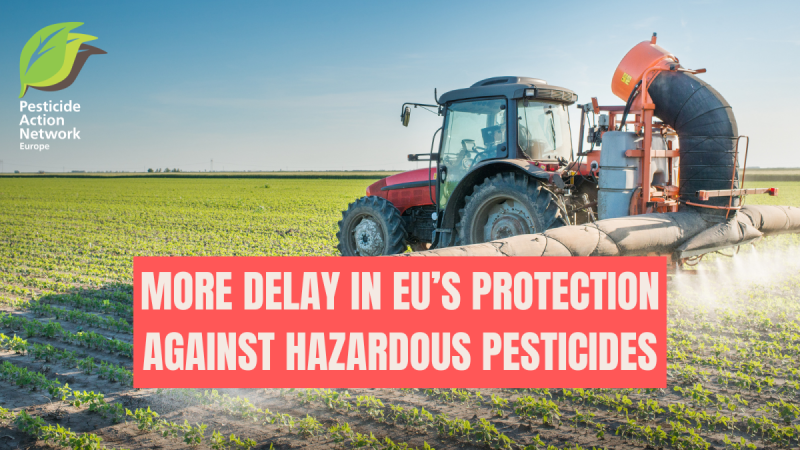
The European Union has been at a standstill for over a year in its meetings to regulate pesticides. Only the endocrine disruptor buprofezin was finally banned in the latest SCOPAFF meeting at the end of September. Hazardous substances such as flutolanil, a PFAS pesticide which should have been banned a long time ago, remain approved. The Member States have just set out their position on the Food and Feed Omnibus, in favour of continuing to use toxic and problematic pesticides. In a letter ahead of the pesticide meeting, PAN Europe highlighted its concerns over these setbacks.
PAN Europe welcomes the adoption of the ban of buprofezin at the SCOPAFF meeting on 24-25 September. This substance has been identified by the European Food Safety Authority (EFSA) as meeting the criteria for an endocrine disruptor for humans in April 2025. It was found to cause adverse effects on the thyroid, which may result in neurodevelopmental toxicity and affect the developing fetus. It is deeply concerning that it took so long for EU decision-makers to protect citizens from exposure to this hazardous substance.
Worryingly, buprofezin is not the only example of how the Commission and Member States knowingly exposed people and the environment to highly toxic substances.
Endocrine disruptors keep piling up
In recent years, EFSA has identified no fewer than seven other endocrine disruptors whose bans are still pending: fludioxonil, fenoxaprop-P, cyprodinil, phenmedipham, cinmethylin, proquinazid and flurochloridone. The most scandalous case concerns fludioxonil, for which EFSA’s conclusions are now more than two years old. In our recent testing, the substance was detected in nearly 40% of apple samples and 39% of strawberry samples. In strawberries, the second most frequently detected substance was cyprodinil, which was found in 33% of the samples. [1] [2]
More than a year of inaction on the PFAS flutolanil
Likewise, progress on the proposal for non-renewal of the PFAS flutolanil has stalled for more than a year. Flutolanil breaks down into trifluoroacetic acid (TFA), contaminating crops, soil, and water. TFA is an ultra-short PFAS, highly persistent, mobile, and soluble in water. ECHA has now recommended its classification as very persistent, very mobile (vPvM), persistent, mobile and toxic (PMT), and toxic for reproduction (Category 1B). [3]
Candidates for substitution also caught in the delay
Pirimicarb is a substance suspected to be a carcinogen and highly toxic to aquatic life. Due to these serious concerns, this substance was included in PAN Europe’s “Toxic 12” list of pesticides to be banned immediately five years ago. [4] The Commission is now proposing the non-renewal of this substance based on an unacceptable risk to residents and bystanders, which EFSA identified as early as 2024. Once again, it is difficult for citizens in rural areas to understand what could justify such delays in taking action to ensure their protection.
More bans are crucially needed but are instead delayed or opposed. This applies to the highly persistent fungicide triclopyr, which poses long-term risks to mammals and high risks to non-target arthropods, and the highly persistent pydiflumetofen. We have urged Member State representatives to immediately support banning these substances.
Bee protection stuck in regulatory limbo
The adoption of the updated Uniform Principles and Data Requirements has been blocked for months, further delaying progress on the protection of bees. This blockade is indeed preventing the adoption of the Bee Guidance Document.
Deregulation agenda
The EU continues to move forward with the deregulation of pesticides, as evidenced by the limited progress in its meetings on substance approvals and bans. In contrast to this gridlock situation for a year, the EU is now rushing to approve the Food and Feed Safety Omnibus, the Commission proposal that could weaken regulations and allow toxic substances to remain on the market even longer. [5]
EU Member States have just set their position in the Commission’s plan to weaken pesticide safeguards for human health and the environment. While the Council wants to restrict unlimited approvals to low-risk substances, it still extends approval periods for substances. The text lacks strong mechanisms to promptly review approvals when new scientific evidence highlights risks to health or the environment, effectively allowing hazardous pesticides that should have been banned to remain in the market for longer. [6]
Learn more: SCoPAFF letter
Notes:
[1] European apples contaminated with cocktails of pesticides
[2] European strawberries extensively contaminated with PFAS or endocrine disrupting pesticide residues
[4] Ban Toxic 12
[5] Omnibus Campaign: For Health, Bees and Farmers
