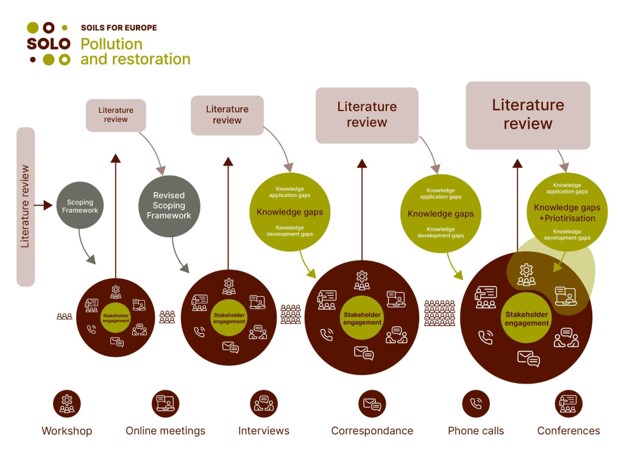
The Institute of Advanced Studies Kőszeg and PAN Europe, coordinators of the Soil Pollution Think Tank (TT) of the Horizon Europe Soils for Europe SOLO project, held a summer webinar focused on reducing and preventing soil pollution, a key objective of the Soil Mission [1]. The project's core objectives include identifying current soil knowledge gaps, needed actions to address them, and bottlenecks which may hamper the actions. These will be included in a Research and Innovation (R&I) Roadmap on soil health.
The webinar’s aim was to discuss specific aspects regarding food system pollution, which is strongly linked with soil pollution. Expert insights foster further understanding of key priorities for incorporation in the SOLO R&I Roadmap. An introduction to the SOLO project and the webinar’s main purpose was given by Kristine De Schamphelaere (PAN Europe) [2].
Preventing soil pollution is one of the top priorities and objectives of the Mission Soil [3]. Knowledge on and awareness of its far-reaching harmful impacts continues to grow. Soil pollution greatly affects biodiversity, ecosystems and their functions, and human health, causing major costs for society. For example, available data show that mixtures of hazardous pesticides are widespread in our soils, water, wider environment, and food. There is an urgent need to recognise and account for the high societal costs of pollution in our soil, food systems and food chains. It is essential to stop soil and food-system pollution at source, ensure implementation and upscaling of available solutions to prevent soil pollution, and transparently inform consumers on the toxic chemicals (used) in the (production of) food they buy.
Invisible Ingredients - Tackling toxic chemicals in the food system - Felix Cornehl [4]
The second presentation was given by Felix Cornehl (Systemiq Ltd.), who provided an overview of key findings of Systemiq’s report Invisible Ingredients - Tackling Toxic Chemicals in the Food System [5]. Systemiq’s purpose focuses on accelerating systemic change for a prosperous, net-zero world. The Invisible Ingredients report represents the most comprehensive global assessment of the harms of 4 toxic chemicals in the food system, with also important links to soil pollution: Phthalates, Bisphenols, Pesticides and PFAS. These chemicals were chosen as they are very prevalent in the food system and have strong evidence related to their harm.
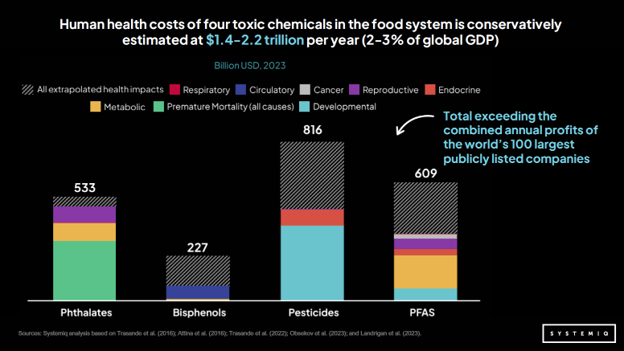
“Globally, our assessment indicates that the combined food-related health costs of these 4 chemical groups amount to around $1.9 trillion, or 2 to 3% of GDP, annually. That is more than the combined profits of the world’s 100 largest publicly listed firms. This is a massive problem,” explained Felix.
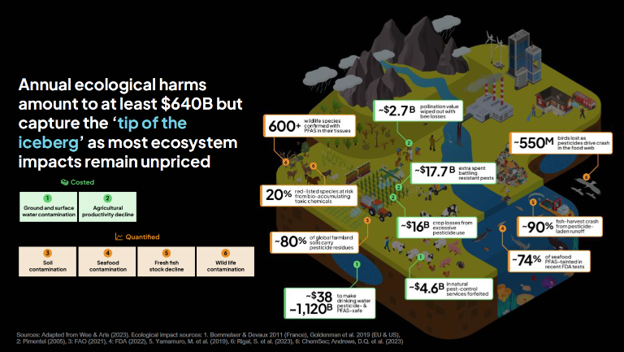
The report also tried to account for some of the ecological harms of these substances, for example, meeting water safety standards for PFAS and pesticides, and productivity losses due to these pollutants. These costs were estimated at at least $640 billion annually, which is, however, only a very small fraction of the ecosystem damages caused by these hazardous chemicals. For example, the cost assessment was not able to quantify and include the costs linked to soil contamination and biodiversity decline.
“The bad news is we have these very severe harms from these hazardous substances. The good news is we think a massive reduction in these substances and their associated harms can be achieved with solutions that are technically available and economically feasible today.”
The presentation zoomed further in on pesticides, chemicals designed to kill living organisms (e.g. pests), but often strike beyond their targets. The report highlights a high reduction potential: in the EU, just by already well implementing current policies and available solutions, it is assessed that, worldwide, at least an 80% reduction of pesticide use can be achieved through the combination of Integrated Pest Management (IPM) (crop rotation, crop cover, natural control and biocontrol, …), organic farming, precision application technologies, safe substitutions (e.g. biopesticides) and innovation and/or scale-up measures.
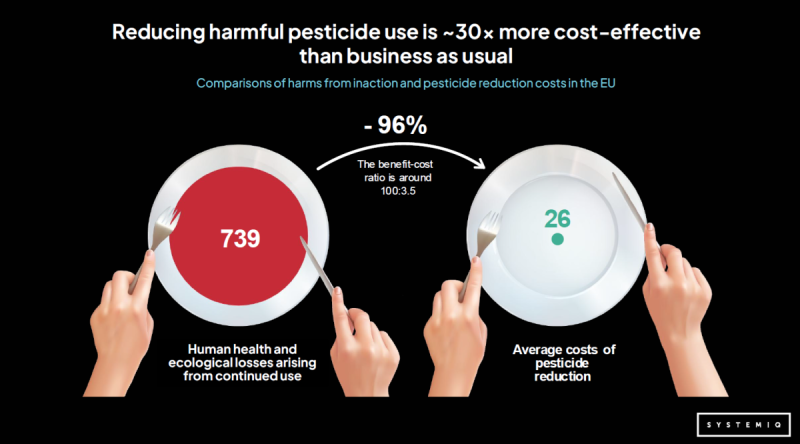
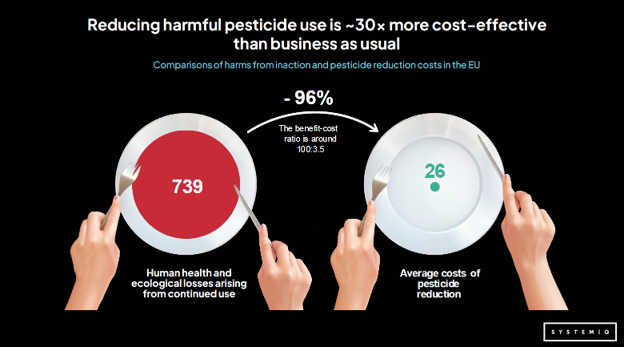
“The cost of pesticide reduction is only 4% of the costs arising from human health and ecological losses if we continue business as usual. Reducing pesticides is not an economic burden. It is a corrective investment that pays for itself many times over, with a benefit-cost ratio of about 100:3.5,” Felix underlines.
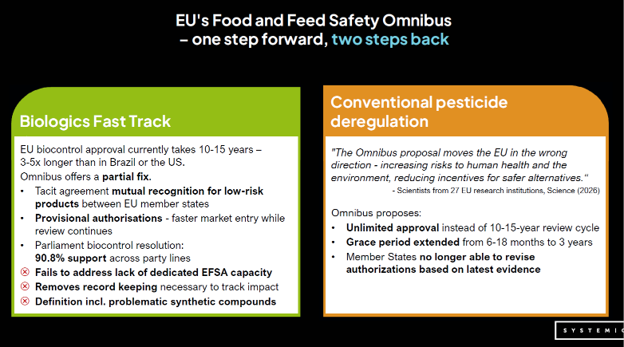
Finally, Felix reflected on the European Commission’s proposed “Food and Feed Safety Omnibus”. The EU is slow to approve and adopt safer alternatives to harmful pesticides, so accelerated authorisation systems are needed. However, the proposal fails to address the lack of dedicated EFSA capacity to evaluate and approve novel safer pesticides, which have to wait in a queue behind re-authorisations processes for older and more toxic pesticides. Although there is a real need to address the delays in authorisation of safe biocontrols, the Omnibus also significantly worsens key elements of pesticide risk assessment and authorisation, which would lead to a one step forward, two-steps-back situation. For instance, the Omnibus proposes to remove critical provisions such as record-keeping of biocontrol, which is needed to track impact, and a too-open definition for biocontrol which could include problematic compounds. The Omnibus also includes deregulation beyond biocontrol, said Felix, referring also to a statement of scientific institutions in the journal Science [6]. Key problematic proposals include unlimited approvals, extended grace periods, and Member States that would not include the latest scientific evidence anymore in the risk assessment and authorisation of pesticide products.
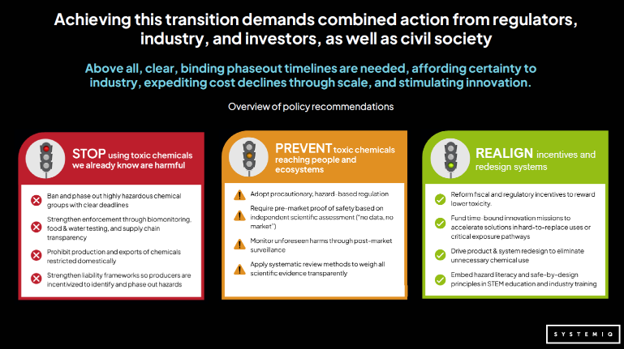
The presentation concluded by underlining that achieving transition demands combined action from regulators, industry, investors and civil society. Above all, clear, binding phase-out timelines are needed, affording certainty to the industry, expediting cost declines through scale, and stimulating innovation. The report proposes a phase-out process based on three main elements of a traffic light: stopping the use of toxic chemicals with already known harms through bans and phase-outs (red), preventing toxic chemicals from reaching people and the ecosystems through precautionary, hazard-based regulation (orange), and realigning chemical-related incentives and design systems, including by embedding safe-by-design principles (green).
Full Video: Invisible Ingredients - Tackling toxic chemicals in the food system - Felix Cornehl
Notes:
[1] Institute of Advanced Studies Kőszeg; Soil Pollution Think Tank (TT); Soils for Europe SOLO project; Soil Mission
[2] Introduction by Kristine De Schamphelaere
[3] Objectives of the Mission Soil
[4] Invisible Ingredients - Tackling toxic chemicals in the food system - Felix Cornehl slides & full video
[5] Invisible Ingredients - Tackling Toxic Chemicals in the Food System
[6] Statement of scientific institutions in the journal Science
Would you like to contribute to the SOLO R&I Roadmap on Prevention of Soil Pollution and Enhancement of Soil Restoration?
PAN Europe co-coordinates with the Institute of Advanced Studies Kőszeg the Soil Pollution and Restoration Think Tank of the Soils for Europe project, a Horizon Europe Mission Soil project. One of the project's core objectives is to develop a Research and Innovation Roadmap on soil health. If you would like to provide recommendations, insights and feedback on the Soil Pollution Think Tank’s preliminarily defined key knowledge gaps, needed actions and bottlenecks (Roadmap on MIRO board), or if you would like to become a Think Tank member to remain updated on the Think Tank’s activities, you are very welcome to reach out to kristine [at] pan-europe.info and judit.pump [at] iask.hu (or comment directly through the Miro board link). The Roadmap aims to include the expertise, knowledge and insights from a wide variety of actors, research and projects. If you would like to reach out to one of the other Think Tanks within the SOLO project, you can find the needed contacts here.