While the environmental and health harm of pesticides are well-known, many people ask: Can agriculture thrive without them? The answer, backed by a groundbreaking 10-year study in France, is a resounding YES. And the benefits extend far beyond mere feasibility. Although pesticide-free systems yields were often below those of conventional farming, some reached equivalent levels or even exceeded them. Moreover, estimated income was twice, three times or more the French national minimum wage in 80% of the monitored arable land.
This 10-year study, led by France’s national agronomic and environment research institute INRAE, analysed nine farming systems - including arable and mixed farming - across various regions of France. [1] The trials were designed collaboratively with farmers and agricultural advisers within experimental units. They used an approach based on agroecological crop protection principles (prevention of the diseases, reliance on plant biodiversity and improvement or protection of soil health), while mineral fertilisers were allowed. The goal was to use zero pesticides while reducing biotic stress (caused by pests, fungi and weeds), with rotations that varied in duration from 5 to 9 years. Even biological pesticides were not used.
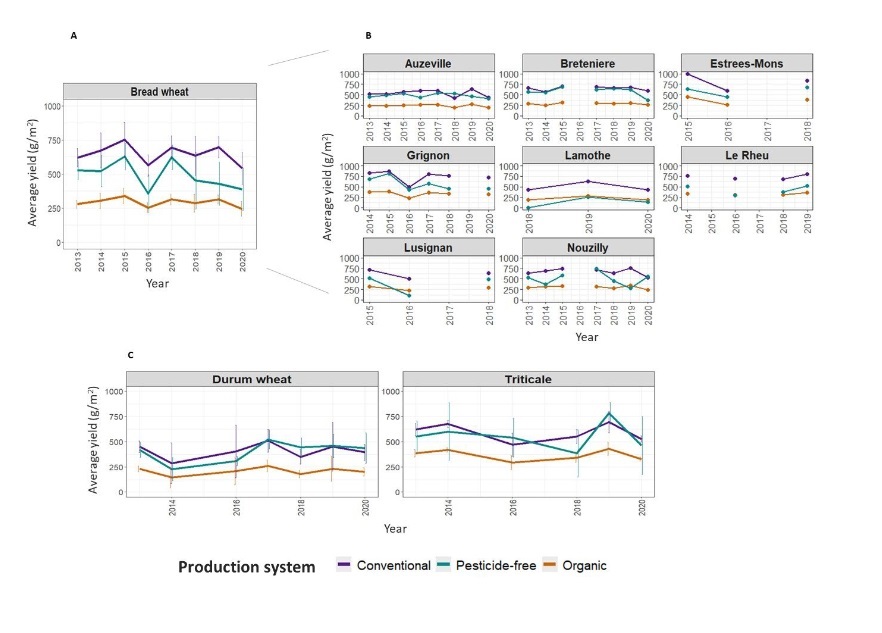
Pesticide-free crops often yielded less than conventional systems using chemical pesticides. When comparing bread wheat, conventional farming yielded on average approximately between 500 g/m² and 700 g/m², whereas pesticide-free farming yielded approximately between 600 g/m² and 400 g/m², and organic farming 250–300 g/m².
However, under certain conditions, pesticide-free crops matched or even surpassed conventional yields. At the Auzeville farm, pesticide-free wheat production exceeded conventional production in 2018, reaching 500 g/m² whilst the conventional version remained at around 400 g/m². The same applies to the production of other crops. For example, pesticide-free durum wheat production reached conventional levels in 2017, while pesticide-free triticale production surpassed conventional production in 2016 and 2019. [2]
Yield objectives were achieved in many site-years, even for crops whose yield performance is considered to be highly dependent on pesticides, such as rapeseed, sugar beet, and potato. It was initially estimated a 50% harvest loss for sugar beet (Beta vulgaris L.). Farmers claim it is highly dependent on insecticides like neonicotinoids. However, over three growing seasons, the yield of pesticide-free sugar beet was double what was initially expected and equivalent to that of conventionally farmed sugar beet in the region during the same seasons. This result is particularly remarkable in France, where the use of neonicotinoids was banned due to health concerns but was re-authorised in 2025 in response to severe damage to sugarbeet crops.
However, ineffective weed management plans and drought were identified as the main factors threatening consistency of pesticide-free crop yields across sites and seasons. These difficulties highlighted urgent avenues for improvement in these systems.
One of the primary concerns among participating farmers was the potential for rising pest populations over time. Surprisingly, after a decade of pesticide-free management, no significant increase in damage from pests or diseases was observed, nor were there notable changes in pathogen or animal pest populations. However, weed management proved challenging in some cases, occasionally necessitating ploughing.
Pesticide-free farming technically and economically viable
Over the 10-year study period, pesticide-free arable cropping systems at four locations (Auzeville, Bretenière, Estrées-Mons and Grignon) produced a satisfactory net profit margin. In 45% of the cases, the estimated income was double or triple the French minimum wage, whereas in 35% of cases it was more than triple the national minimum wage. Lastly, in 20% of cases, the estimated income was equal to or doubled the French national minimum wage.
Farms that performed less well (4 of 9 farms) were mixed farms (3 out of 4). Other parameters than crop yields, linked to livestock economics, thus intervened in those farms' profitability. At sites Le Rheu, Lusignan, Nouzilly, and Mauguio, net farm incomes fell below one minimum wage.
This study shows that pesticide-free arable farming is possible in France. It is also productive, technically and economically viable. According to the researchers, achieving this requires diversifying crops, implementing long crop rotations, building targeted marketing channels and assigning fair economic value to the products these systems yield. Most importantly, strong public policies are needed to support and scale up these innovative approaches.
Main changes in practice
This experiment included two key elements in practice: one, the exclusion of all pesticides, including seed treatments; and two, the requirement to include arable crops that are representative of typical farms in each region, including those integrated with livestock systems.
Perennial species, cultivated as sole crops or in intercrops, such as the legumes alfalfa (Medicago sativa), sainfoin (Onobrychis viciifolia), purple clover (Trifoliumpratense) and white clover (Trifolium repens), ryegrass (Lolium perenne) and sweet grass (Hierochloe odorata), were included in rotations as temporary meadows for up to three years. The inclusion of at least one agroecological infrastructure element, such as a grass strip, hedgerow, or floral strip, was mandatory.
Furthermore, crop sequences were more diversified than typical French sequences for arable crops. The core practice to prevent pest attacks was diversification, including new crops such as soybean and hemp, the diversification of sowing dates, the use of resistant or tolerant cultivars, and the use of mechanical weed management collectively.
According to the report, practices such as tillage, intercropping, relaycropping, and the sowing of cover crops can further enhance soil health by preserving its chemical and biological properties.
Leguminous plants and crop rotation
Incorporating leguminous plants into crop rotation systems offers significant agronomic and environmental benefits. Leguminous plants have nitrogen-fixation properties, reducing reliance on synthetic, fossil fuel-derived fertilisers. Additionally, the abundant, protein-rich pollen produced by leguminous plants helps pollinator populations in intensive agricultural landscapes. [3]
Crop rotation is an essential element of IPM (Integrated Pest Management). This technique involves not cultivating plants from the same species or family on the same plot of land before a few years. The main benefit of crop rotation comes from the fact that pests and pathogens are host-specific, which means they rely on the presence of a particular crop species or family to complete their life cycle. When that crop is grown repeatedly in the same location, pest populations can increase dramatically since the conditions for feeding and breeding remain stable. By rotating to a different crop that the pest cannot use as a food source, the cycle is disrupted. Over time, pest populations decline naturally due to the absence of suitable hosts. [4]
An urgent change of pace
The massive and widespread use of pesticides harms our soil, contaminates our water, and pollutes the air. Beyond the ecological damage, it threatens human health and imposes heavy economic burdens on both society and the farmers who rely on them. Furthermore, as this study has shown, pest control via the building of natural pest predators and plant health through healthy soils is crucial to stop our dependency on pesticides. On the contrary, pesticides destroy beneficial insects and soil life.
According to this study, “although pesticide regulations in EU agriculture have led to the removal of a considerable number of hazardous and widely used substances from the market (...), a disruptive shift, such as striving for a completely pesticide-free culture, is necessary to achieve a profound transformation.” This conclusion directly contradicts the current direction of the European Commission.
The ongoing Omnibus Regulation proposal could allow harmful pesticides to remain on the market by undermining the use of up-to-date scientific evidence in decision-making processes. [5] This would pose citizens and the environment at unnecessary risk. PAN Europe and its partners have launched a campaign enabling citizens to urge EU decision-makers to reject the proposal and defend stronger pesticide protection. You can sign here.
Notes:
[1] Ortiz-Vallejo D., Cellier V., Deytieux V. et al. (2026). Pesticide-free agriculture: is a third way possible besides organic and conventional agriculture?
[2] The researchers chose wheat as an example, as it is the only crop in the network produced in eight different French regions over several years. Information about the average yield of bread wheat produced conventionally and organically was obtained from the Agreste (2023a, 22023b) database.
[3] Cole L et al. (2022) Supporting wild pollinators in agricultural landscapes through targeted legume mixtures
[4] Farming Beyond Pesticides (PAN Europe, 2025)
