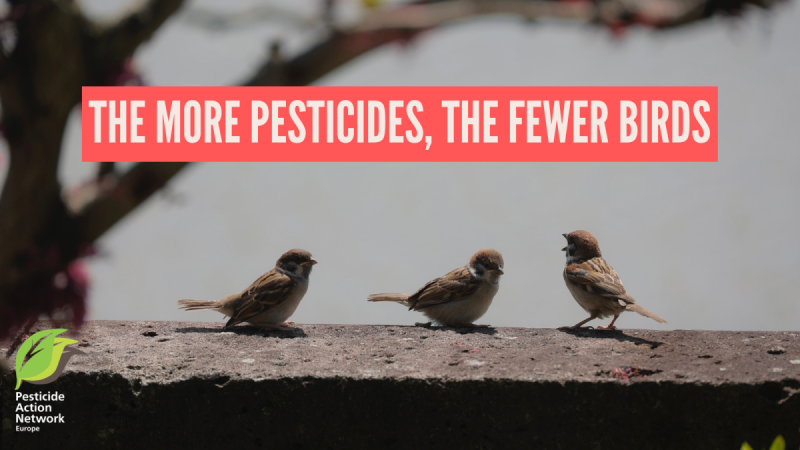
A recent French study shows that common birds are far less abundant in agricultural areas where more pesticides are purchased. Negative effects were found for over 84% of the species studied. A reduction in pesticides would be a turning point in halting biodiversity loss, according to the scientists. But instead of addressing this, the EU is paving the way to keep harmful pesticides on the market indefinitely.
Researchers from the National Museum of Natural History in France (MNHN) compared local sales in France of 242 pesticide active substances with citizen-science data on 64 bird species. They found negative effects for more than 84% of the species studied. This negative relationship was significant for 25 species, with only one species displaying a significantly positive correlation between abundance and pesticide quantities. [1]
“That is to say the more pesticides are sold, the fewer birds there are,” Anne-Christine Monnet, co-author of the study, explained to AFP. "We can conclude now that a reduction in pesticide use is necessary to mitigate current losses of agricultural biodiversity," the researchers stated. [2]
According to the study, the impact of pesticides on birds can be either direct or indirect. Direct exposure occurs when granivorous birds ingest treated seeds or when insectivorous birds, raptors, or scavengers consume contaminated prey. On the other hand, indirect effects come from the depletion of food sources.
This study not only focuses on birds that specialise in agricultural environments, but it also highlights the negative effects of pesticides on other species that occasionally frequent these areas to nest or feed. Among the species whose populations declined in correlation with pesticide levels, both the common nightingale (Luscinia megarhynchos), a generalist species, and the common chiffchaff (Phylloscopus collybita), a woodland specialist. They were detected in more than 75% of the count points located in croplands. The researchers also stress “the potential cascading effects within and outside these landscapes.”
The negative association between pesticide use and bird abundance remained strong even after accounting for other factors linked to agricultural intensification, such as the use of fertilisers and landscape structure. This highlights pesticide use as a main cause of bird declines in agricultural ecosystems.
Mass extinction of insects due to pesticides
As we emphasised in our report “Licence to kill’, insect and arthropod populations are collapsing across Europe, with pesticides playing a major role. In some regions, insect biomass has declined by an alarming 75% over approximately 25 years. The EU has failed to protect them, relying on a flawed, industry-influenced guidelines to authorise pesticides that can kill half of non-target arthropods in a single spraying, under the false assumption that populations recover easily. [3]
Although the EU is now revising this document, the EFSA-selected panel in charge appears to lack the independence and expertise needed for a real reform, as revealed by PAN Europe. [4]
Additionally, instead of taking steps to preserve our biodiversity and health as citizens and scientists from all over Europe demand, the EU has recently opened the door to unlimited pesticide approvals. This would mean a significant weakening of the actual pesticide legislation. However, strong evidence from studies like this one underlines the need for more ambitious measures against pesticides to protect our health and biodiversity. [5]
Scientists warn of accelerated biodiversity loss
This study adds to the already strong scientific evidence showing that pesticides are a key driver of biodiversity decline, which also affects birds and the entire ecosystem. A 2025 meta-analysis of 1,705 studies confirmed that pesticides are widely toxic to many non-target organisms. The paper showed that while pesticides are often defended for their low financial cost, this ignores their significant hidden costs to wildlife and ecosystems. [6]
A study published last year by researchers at the University of Kaiserslautern-Landau was the first to track pesticide contamination over the course of an entire year. The researchers detected a cocktail of pesticides not only during spraying periods in fields, but also year-round and in nearby meadows. “If we want to protect insects, we need to stop or significantly reduce pesticide use on a much larger scale,” said Professor Carsten Brühl, an ecotoxicologist at the university in an interview [7].
Our actual agricultural system is heavily reliant on pesticides and seriously impacts biodiversity. That makes the model unsustainable. We urgently need to change course to save arthropods, birds, animal life, and ultimately, ourselves.
Read more: Restore biodiversity - protect bees and bugs
Notes:
[1] Study: Common birds have higher abundances in croplands with lower pesticide purchases - Anne-Christine Monne, Milena Cairo, Nicolas Deguines, Frédéric Jiguet, Mathilde Vimont; Colin Fontaine, Emmanuelle Porcher, January 2026
[2] The more pesticides sold, the fewer birds there are - La Libre Belgique
[3] Licence to Kill: EU guideline to protect insects failed to block harmful pesticides
[4] No insect expert in EFSA working group on new insect pesticide guideline
[6] Pesticides found widely toxic to non-target organisms in low concentrations
[7] A cocktail of pesticides eradicates biodiversity - Interview with Prof. Dr. Carsten Brühl
