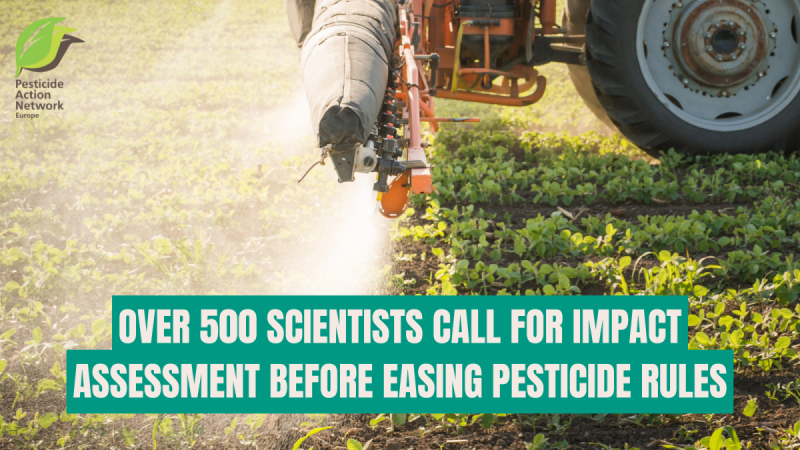
In a letter sent today, over 500 scientists, practitioners, and public health and environmental officials have raised concerns about the rapid pace for the Food and Feed Safety Omnibus, the EU Commission’s proposal to loosen pesticide regulations. They ask the European institutions for a pause in the political debate until a thorough, independent evaluation of its health, environmental, and administrative impacts is conducted.
The letter was submitted by the professor Martina Vijver (Leiden University) and co-signed by 573 other scientists to the European Parliament and the Council. [1] According to them, a reform of the magnitude of the Food and Safety Omnibus would normally require a detailed upfront assessment of its potential impacts, yet no such evaluation has been provided to lawmakers.
“Given the scale of the changes under consideration, and in a broader context in which the scientific community is increasingly called upon to warn of cumulative environmental and health pressures, we believe that responsible policymaking calls for caution rather than speed,” the letter says.
Since the Omnibus proposal was presented in December last year, the scientific and research community has been raising the alarm. As highlighted in the letter, an independent assessment commissioned by the Dutch Parliament already raised concerns about it. Although the proposal is framed as a simplification effort, the scientists found that it will not reduce administrative burdens or speed up pesticides authorisations. Instead, it raises serious concerns about the protection of human health and the environment, as well as the shifting of the burden of proof from pesticide producers to society. [2]
In June, a new scientific analysis published in Science warned that the Omnibus proposal would increase risks to human health and the environment and reduce incentives for safer pest-control alternatives. [3] This is in addition to publications by various universities and experts highlighting the gaps and urging caution regarding the proposal, such as Germany’s National Academy of Sciences, Leopoldina, researchers from Germany and the Netherlands, and a research team at Stockholm University, as the letter highlights. [4]
More signs to carry out an impact study
For the experts, there are several clear indications that a comprehensive impact assessment is required, although so far the possibility has been rejected within Parliament. This year the European Food Safety Authority itself pointed out that a slight increase in its own resources could resolve the backlog in the processing of applications, as an alternative to the actual proposal. [5] Importantly, in a hearing at the European Parliament, the lawmakers heard a “constellation of experts mostly related to those with agroindustrial relationships whilst one independent scientist was heard”. In their opinion, “an impact assessment therefore appears even more useful,” as it can provide transparent and harmonised criteria on efficiency and health consequences to humans and ecosystems, allowing a conscious decision. [6]
“For us scientists, the most important concern is that the regulatory system must remain capable of correcting yesterday’s decisions with tomorrow’s knowledge. This concern must be shared by the European Parliament [...]. In all cases, we consider a bare minimum that the concerns of science are acknowledged for in the impact assessment and implementation,” the letter highlights.
A pause in the debate
As a conclusion, the scientists ask for “pausing the debate of the Food and Safety Omnibus until an independent assessment, whether carried out by Parliament's own research service or by an equivalent independent body, comparable to the one already commissioned by the Dutch Parliament, is available to inform it.”
The European Commission’s Omnibus proposal was presented in December last year, and it was expected that within less than a year the legislative bodies (the Council and the Parliament) would finalise their positions for the final negotiations. The Omnibus proposal consolidates ten separate food and feed safety laws into a single package, addressing areas such as pesticide approvals, maximum residue limits of substances per product, or controls on imported food.
Notes:
[2] Scientific assessment slams food and feed safety omnibus proposal
[3] New science warning raises alarms over EU pesticide Omnibus
[4] Joint Scientific Statement on Pesticides in the Omnibus Package (December 2025).
- Douhaire, C. and Haug-Jurgan, Y. (January 2026). The Lawfulness of the Planned Amendments through the “Food and Feed Safety Omnibus”
- Wintermantel, D. et al., (June 2026). EU Omnibus Proposal Increases Pesticide Risks
- Teppe, K, and Backhaus, T, (July 2026). Simplification and the Level of Protection: Primary Law Limits and Legislative Discretion in the Food and Feed Safety Omnibus
- Leopoldina, (June 2026). Planned Amendment to the Authorisation of Plant Protection Substances: EU Commission Proposals Reduce the Level of Protection for Humans and the Environment
[5] Omnibus: EFSA proposes safer and faster alternative to unlimited pesticide approvals
