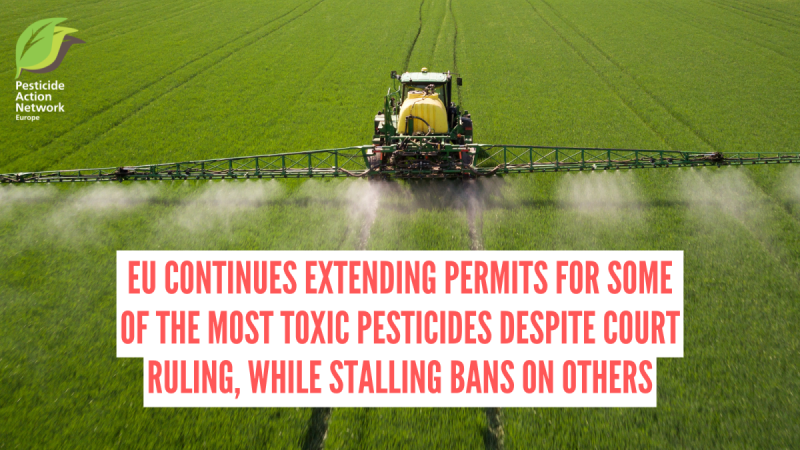
This month's EU pesticide meeting presents a mixed picture. We finally see some long-overdue ban proposals on substances harmful to humans and wildlife under consideration. However, political deadlock persists on banning endocrine disruptors and PFAS pesticides. In the meantime, the extended use of some of the most hazardous pesticides is proposed. PAN Europe calls on the Commission and Member States to ensure priority is given to the protection of human health and the environment.
One of the most concerning proposals is the extension of approval periods for substances of high concern. The Commission proposal includes lambda-cyhalothrin, deltamethrin, fluopicolide, chlorotoluron, and benzovindiflupyr. Four of these substances are candidates for substitution, including two that are PFAS. Notably, lambda-cyhalothrin and chlorotoluron appear on PAN Europe’s “Toxic 12” list of pesticides that should be banned immediately. [1] While not being a candidate for substitution, deltamethrin is now suspected to damage the brain development of young children. [2]
It is striking that these proposed extensions come just after a landmark judgment by the EU General Court, in cases brought by PAN Europe and other NGOs. [3] The Court clarified that an extension of approval must be exceptional, temporary, and based on concrete progress in risk assessment. It also emphasised the need to assess whether producers contributed to delays by providing inadequate or incomplete data. Despite this, the Commission is proposing to prolong approvals for very problematic substances, undermining EU rule of law and the protection of human health and the environment.
A ban on one PFAS pesticide, green light for others?
The Commission’s proposal to ban flutolanil, a PFAS pesticide that breaks down into trifluoroacetic acid (TFA), is a welcome step. TFA is highly persistent, mobile in water, toxic to reproduction, and increasingly detected across Europe in tap water and food products. PAN Europe strongly supports this ban, which has faced political blockage for over a year. [4]
However, other proposals raise serious alarms. Penoxulam, structurally similar to flutolanil and a potential TFA precursor, is being discussed for renewal for rice use, due to the absence of data demonstrating TFA formation as a breakdown product. PAN Europe strongly opposes this renewal, as the industry studies provided are unsuitable to detect TFA, and its formation is scientifically foreseeable. Similarly, diflufenican, a widely used PFAS herbicide, has been shown in a Danish study to degrade into TFA under real-use conditions, contaminating groundwater. Yet EFSA’s review failed to recognise this as a critical concern, due to the absence of industry data, only noting aquatic toxicity.
Endocrine disruptors
A welcome step is the Commission’s proposal to ban buprofezin, identified as an endocrine disruptor affecting humans. However, other endocrine-disrupting pesticides identified by EFSA, cyprodinil, fludioxonil, and fenoxaprop-P-ethyl, remain under consideration for renewal, with Member States seeking derogations to bypass safety criteria. [5] New endocrine-disrupting pesticides on the agenda, such as cinmethylin and phenmedipham, highlight the urgent need for further and faster action.
Other problematic substances
PAN Europe supports the proposed non-renewals for pirimicarb (Toxic 12, carcinogen, highly toxic to aquatic life) and triclopyr (highly toxic to mammals and non-target arthropods).
However, the Commission is proposing the approval of pydiflumetofen, a highly persistent fluorinated fungicide, despite the known risks of environmental accumulation and irreversible effects. Similarly, mecoprop-P is proposed for renewal, even though it poses unacceptable risks to children and the environment.
Weakening EU protection
Through our SCOPAFF letter, we also made clear to the Commission and Member States how strongly we oppose the Food and Feed safety omnibus proposal. This proposal represents a serious weakening of EU law on the protection against synthetic pesticides. It grants unlimited approvals for active substances, including PFAS and neurotoxic pesticides, while restricting Member States’ ability to use the latest scientific evidence in their national assessments. Grace periods for substances that no longer meet approval criteria could be extended by up to three years, further normalising exposure to dangerous chemicals. [6]
Learn more: SCoPAFF letter
Notes
[2] Pesticide deltamethrin causes brain damage in offspring at 'safe' dose | PAN Europe
[6] Position paper: ‘Food and feed safety omnibus’ threatens EU pesticide rules
