Pesticide sales in the EU rose by 8% in 2024 compared to the previous year, reaching 316.000 tonnes, according to the latest Eurostat data. The new data refute the Commission’s claim of a 61% reduction in pesticide use, a figure based on a flawed indicator. The EU is far from the objective of gradually reducing farmers' dependency on pesticides. In addition, with its recent Food and Feed Omnibus proposal, the Commission seeks to prolong the presence of hazardous pesticides on the market.
In 2024, the most recent year for which data is available, the top five purchasing countries -Spain, France, Italy, Germany, and Poland- showed an upward trend, with sales nearly 10% higher than in 2023. Together, these countries, which are also the EU’s leading agricultural producers, accounted for 76% of total pesticide sales that year.
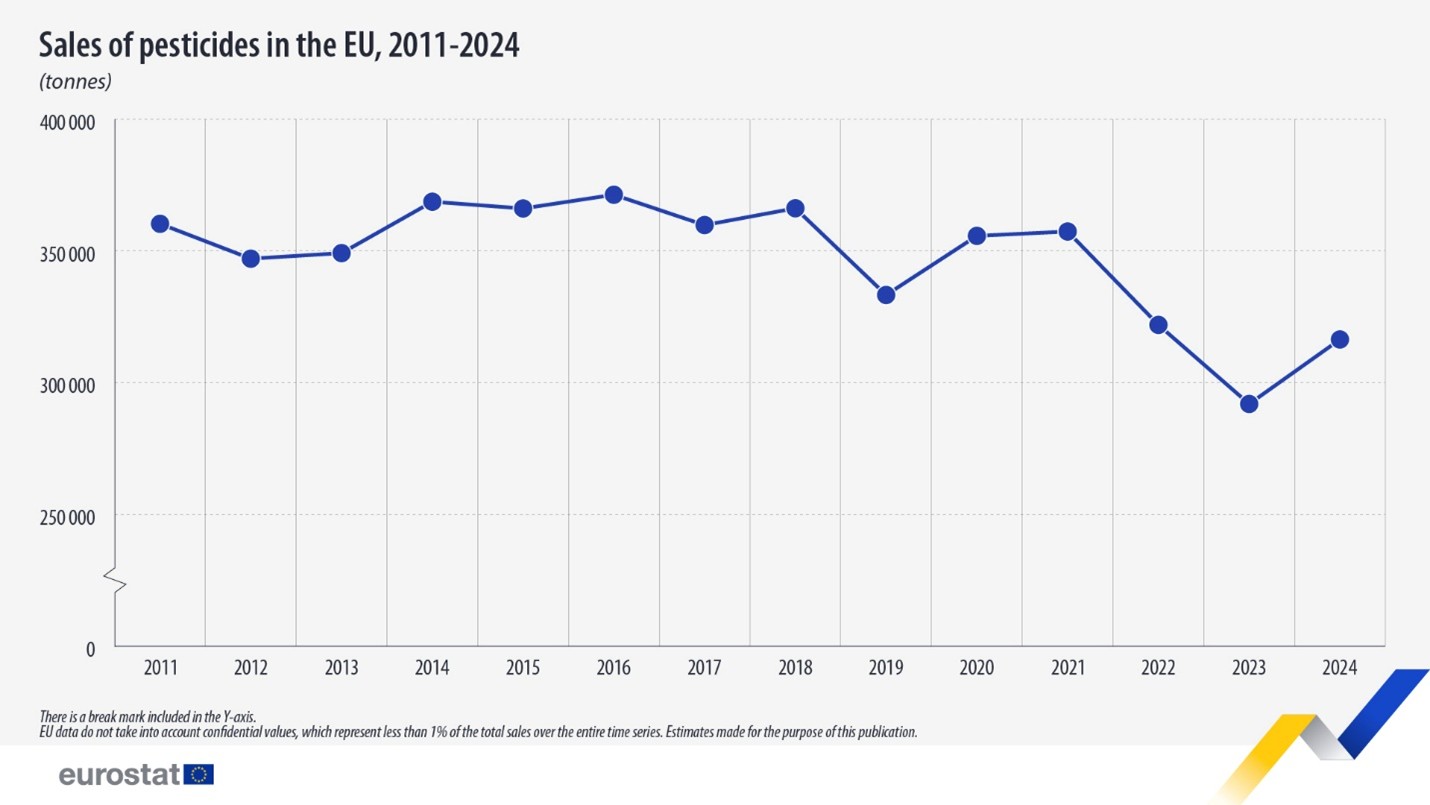
The Eurostat website states that this is the second-lowest recorded figure for pesticide sales in the EU since 2011. While 360,000 tonnes of pesticides were sold in 2011, sales in 2024 stood at 316,000 tonnes. In total, there has been a 12% reduction in pesticide sales, which is far from the 61% decline in usage claimed by the Commission since the 2011-2013 baseline period. PAN Europe filed a complaint to the European Ombudsman in 2025. [1]
Unfortunately, in their headline communication, Eurostat's presentation of the sales is deceptive as the Y axis is designed in a way that it seems the pesticide reduction is significant, while it is not: it gives the impression that the difference between the highest year of sales and the lowest is 50%. Further down in the article, the Y axis is not modified and the image is completely different. In addition, Eurostat mentions a "sharp decline" in pesticide sales in 2021 and 2022 (~10% decrease) but fails to mention a "sharp" rebound of sales in 2024.
.png)
These figures fall far short of the EU’s objective to gradually reduce farmers' dependency on pesticides, under the directive on the sustainable use of pesticides (SUD, directive 2009/128/EC). These figures confirm the disinterest from both the European Commission and Member States on properly implementing the SUD, and supporting farmers with independent advice on how to replace toxic pesticides with preventative and non-chemical approaches. In addition, with its recent Food and Feed Omnibus proposal, the European Commission seeks to extend the market presence of hazardous pesticides, effectively giving a big present to the industry, while reducing the level of protection for farmers and citizens' health, as well as the environment.
How a wrong indicator enables the Commission to claim pesticide reductions
The European Commission frequently highlights a supposed decrease in pesticide use and risk across Europe, relying on a controversial tool called the Harmonised Risk Indicator 1 (HRI1). The HRl1, adopted by EU member states in 2019, was designed to measure both the use and risk of pesticides. However, it has faced strong criticism from scientists, and even the European Court of Auditors, for producing misleading results.
One of the main issues is that the HRI1 creates artificial reductions in pesticide use. For example, when a pesticide is banned, the indicator applies a mathematical adjustment that makes it appear as if its use has dropped dramatically, even if it has simply been replaced by another equally toxic substance. This means the reported decreases do not reflect actual reductions in toxicity on our fields. Additionally, the HRI1 fails to account for real-world risks, such as the chronic toxicity of pesticides to humans, the environment, or water pollution.
Another problem is the indicator’s bias against natural substances. Studies, including a report by the NGO GLOBAL 2000, show that HRI1 exaggerates the risks of natural substances used in organic farming compared to synthetic pesticides. For instance, it assigns over 800% more risk to potassium bicarbonate -a harmless substance also used in baking- than to difenoconazole, a synthetic fungicide known to be highly toxic and persistent. By overstating progress, the HRI1 undermines the EU’s credibility. [3]
At the end of last year, PAN Europe, jointly with IFOAM Organics Europe and Global 2000 filed a formal complaint with the European Ombudsman. We challenged the European Commission’s deceptive communication based on the use of the indicator HRI1 to measure pesticide use and risk, arguing that it breaches the Commission’s duty of accuracy and transparency. We asked the Ombudsman to investigate whether this amounts to maladministration. [4] In a decision from November 2025, the Ombudsman refused to open an inquiry, considering the fact that the European Commission admits the deficiencies of HRI1 and is currently working on alternative options. [5] PAN Europe's view is that the European Commission should not communicate on pesticide use and risk based on a flawed indicator, and will further advocate for a scientific and honest way to communicate on pesticide trends in the EU.
Read more: Sales of pesticides in the EU in 2024 (Eurostat, May 2026)
Notes:
[2] Trends in Harmonised Risk Indicators for the European Union
[3] HRI1: A risk indicator to promote toxic pesticides? (Global 2000, 2022)
