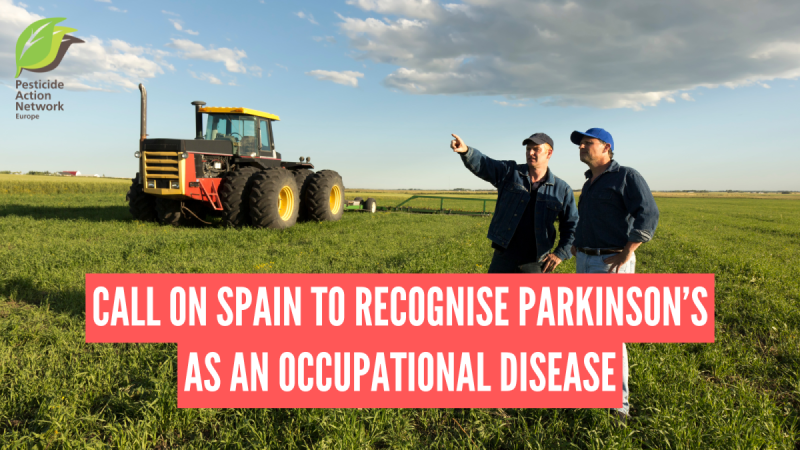
Environmental and health organisations in Spain have urged the government to urgently classify Parkinson's disease as an occupational illness for farmers exposed to pesticides. They also called for epidemiological research into pesticide exposure and the development of the disease in Spain. The prevalence of Parkinson's disease has doubled worldwide in the last 25 years. France, Italy and Germany have already recognised it as an occupational disease for farmers.
Parkinson’s disease is now the fastest-growing neurological condition, and evidence shows a strong link to long-term pesticide use. [1] Ecologistas en Acción, the Spanish Society of Organic Agriculture (SEAE) and WWF Spain have urged the Spanish Government to take immediate action to address this growing public health crisis. A new documentary, Parkinson Tóxico (Toxic Parkinson’s), features testimonies from scientists and agricultural workers who have developed Parkinson’s disease after prolonged exposure to pesticides.
A global health crisis linked to pesticides
According to the World Health Organisation (WHO), the prevalence of Parkinson's disease has doubled worldwide over the past 25 years. While genetic factors play a role, the WHO's 2023 report emphasised that exposure to environmental pollutants, particularly pesticides, significantly increases the risk of developing the disease. [2]
More than 150,000 people in Spain are living with Parkinson's disease, with approximately 10,000 new cases being diagnosed annually. The figure has doubled over the last 14 years in the country, and projections suggest it could triple within the next 30 years. Despite these alarming statistics, Parkinson's disease associated with pesticide exposure is not recognised as an occupational illness in Spain. [3]
Furthermore, no dedicated epidemiological studies have been conducted to assess its prevalence among agricultural workers, despite Spain being one of the EU’s highest users of pesticides. Spain has long been the EU’s top user of pesticides on crops that feed millions, both domestically and abroad. According to FAO, since 2000, over 1.3 million tonnes of pesticides have been applied to Spain’s agricultural land. [4]
Several European countries, including France, Italy, and Germany, recognise Parkinson’s as an occupational disease in agriculture when linked to pesticide exposure. This recognition ensures affected workers receive compensation, medical support, and legal protections.
The organisations emphasise that, although some cases of Parkinson's disease are unavoidable or difficult to find the cause, those associated with pesticide exposure can be prevented. They are calling for a reduction in the use of pesticides and the risks of exposure, as well as ensuring that affected workers are recognised and compensated. They are also requesting accelerated research to improve understanding of the occupational causes of the disease and how to mitigate them.
Paraquat and glyphosate link to Parkinson's disease
Exposure to paraquat is strongly associated with an increased risk of developing Parkinson’s disease. While paraquat has been banned in the EU, China and Brazil, among numerous other countries, its use remains authorised in the US.
Glyphosate, on the other hand, is the EU’s most widely used herbicide. Its authorisation was extended by the EU despite the scientific evidence of its harm to human health and the environment. This is why PAN Europe and five of our members have taken legal action against the EU Commission and Bayer, the main producer of glyphosate, who have recently joined the case as defenders. [5]
Pesticides can have very serious and lasting effects on our brains. It is therefore completely incomprehensible that pesticides are still hardly tested for their long-term effect on the brain and nervous system before being authorised for use. We advocate for a thorough reassessment of all pesticides currently approved in the EU and a swift ban of all substances that show neurotoxicity.
Read More and watch
- Campaign: Ecologistas en Acción, SEAE and WWF call on the Ministry of Labour to recognise Parkinson’s disease as an occupational illness caused by pesticide use
- Documentary: Parkinson tóxico by Santiago Donaire
- Support the campaign to recognise Parkinson as an occupational disease in Spain
- Save our Brain campaign by PAN Europe
Notes:
[1] E Ray Dorsey, Bas Bloem et al. (2018), The Emerging Evidence of the Parkinson Pandemic
[2] Parkinson disease by the World Health Organisation (WHO)
[3] Data from the Spanish Society of Neurology (SEN)
[4] FAOSTAT, 2025. Data on pesticide use
