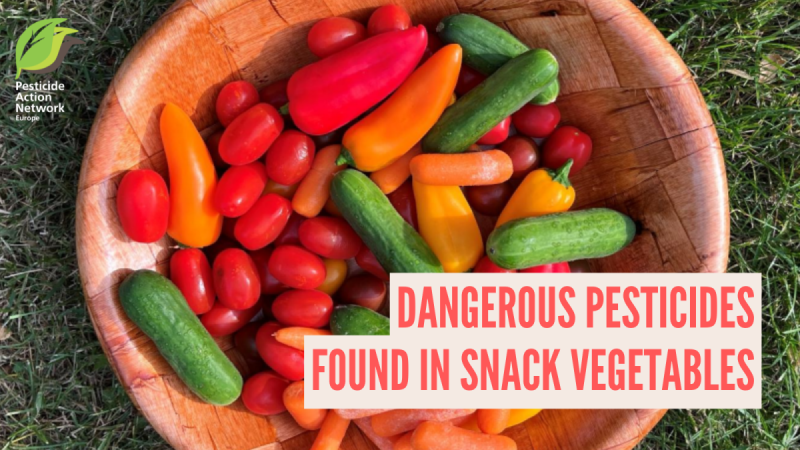
Snack vegetables are supposed to be a healthy, easy way to get kids to eat more greens. However, a new report by our member PAN Netherlands has sent shockwaves through the country, also resonating in the Dutch-speaking part of Belgium. While some snack vegetable samples were clean, other batches of these nice little tomatoes, cucumbers and peppers contained unpleasant surprises: PFAS pesticides, endocrine disruptors and a suspected carcinogen. Not exactly what you would like to give to toddlers. Another example of why we need better protection, instead of the weakening of the pesticide regulation as proposed by the EU Commission. What is going on?
Together with consumer TV program Kassa, PAN NL tested 20 snack vegetables, products often eaten by children and promoted by supermarkets. The good news is that the ‘planet-proof’ samples grown in greenhouses in the Netherlands were clean, without residues. However, some other batches, especially those grown in Morocco but also one from Spain, contained dangerous pesticides. Although each individual pesticide was below the current Maximum Residue Level (MRL), no one knows what the combined effect can be. This is particularly concerning for vulnerable young children whose brains are still developing.
Aldi’s Moroccan cherry tomatoes were the most contaminated, containing two endocrine disruptors, one suspected carcinogen, two PFAS pesticides, and three ‘candidates for substitution’ - pesticides flagged to be urgently replaced with safer alternatives because of their high toxicity. A batch of Spanish sweet cucumbers from PLUS Supermarket contained up to six pesticides.
Cherry tomatoes were found to be the most contaminated product overall, containing between three and seven different pesticides, which gives an average of more than four. None of the (lightly scraped) baby carrots were found to be contaminated. In total, 38 pesticide residues were detected across 20 products, an average of almost two per product.
Strict limits for processed baby food, not for fresh vegetables
If these levels of pesticide residues were found in baby food, 11 of the 20 samples would have been banned. In contrast, fresh snack vegetables are allowed up to 1,000 times higher pesticide limits than baby food.
Sjoerd van de Wouw, a researcher from PAN-NL, said: “Supermarkets need to pay more attention to young children and provide pesticide-free products. That way, parents can teach their children to eat vegetables without worrying about harmful chemicals, something that’s already hard enough.”
Advice for parents
PAN-NL does not want children to eat fewer vegetables. Children already don’t eat enough. Eating fewer vegetables is therefore not a solution. Instead, choosing organic more often, or choosing the less contaminated ones, can help reduce exposure – particularly for children and pregnant women (and their unborn babies).
Better - not weaker - protection
This case highlights once again that we need stricter protection against pesticides. Yet instead of strengthening protection, the EU Omnibus proposal would weaken current rules by extending indefinitely the approvals of synthetic pesticides and keeping those that should be banned longer in the market. Across Europe, citizens, scientists and organisations are calling for a systemic change towards a pesticide-free agriculture, to ensure the protection of health, the environment and sustainable food production. [1]
Read more: Snack Vegetables, full of vitamins and minerals and ... 17 pesticides (PAN NL, in Dutch)
Notes:
