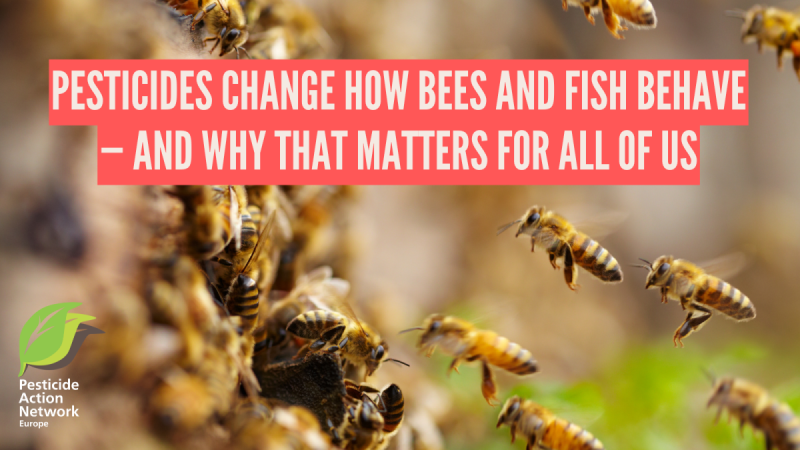
A new study from the German Helmholtz Centre for Environmental Research (UFZ) uncovers something troubling: even very small amounts of commonly used pesticides can significantly change how bees and fish behave. And these behavioural shifts could ripple across entire ecosystems. The study concludes that relevant behavioural tests should be included in the regulatory risk assessment.
Pesticides spread by wind, water and dust. Rain washes them into streams and rivers. Pollinators encounter them while collecting nectar. Aquatic animals absorb them as residues accumulated in water bodies.
That means species that aren’t supposed to be affected — the so-called “non-target organisms” — are often exposed anyway. According to Prof. Martin von Bergen from UFZ, one of the two co-leaders of the study, this exposure can happen at surprisingly high levels:
“Wild bees can come into contact with significant concentrations shortly after spraying. Aquatic animals are at risk as well.”
Small doses, big behavioural changes
The UFZ team set out to understand what happens to animals before pesticides cause physical harm — specifically, how their behaviour changes. This matters because behaviour is often the first trait to be disrupted. And small disruptions can escalate into significant ecological problems.
The researchers focused on two model species:
- Honeybees (Apis mellifera), representing pollinators
- Zebrafish (Danio rerio), a stand-in for aquatic wildlife and a widely used model in science
Each was exposed to pesticide concentrations that genuinely occur in fields and waterways.
What happened to the bees?
The results were striking:
- Insecticides reduced foraging activity and disrupted how bees process nectar
- Fungicides and herbicides weakened brood care, making bees less attentive to developing larvae, with potential negative impact over several generations
- A significant increase in the number of waggle dances was observed in all treatments in comparison to the control, suggesting an alteration in the communication efficiency between forager bees
These aren’t minor quirks — they threaten colony stability, reproduction and pollination performance. If bees cannot forage or communicate effectively or care for their young, their survival is at risk.
Fish showed clear signs of confusion
Zebrafish embryos were tested using an innovative screening tool that detects changes in learning and memory. The data obtained indicate that zebrafish displayed significant changes in behaviour, when exposed to a representative pesticide mixture that mimics concentrations detected in European waters. When considering the omnipresence of multiple pesticide residues in European rivers and streams, these results are alarming.
Pesticide mixtures at levels commonly found in German rivers caused different effects:
- At low concentrations, fish behaved as if exposed to herbicides
- At higher concentrations, they responded more like they were exposed to fungicides
This shows that chemical mixtures can interact in unexpected ways — and even environmentally “normal” accepted exposures can disrupt neurological development.
The hidden danger: chemical mixtures
One of the most important conclusions of the study is that chemicals do not act alone in the real world. Humans and animals are exposed to cocktails of pesticides, not just one at a time. Prof. Tamara Tal from UFZ emphasises: “Mixtures can trigger complex behavioural changes, even at concentrations we consider low.” This means that current regulations — which often evaluate chemicals individually — may vastly underestimate their real ecological impact.
A call for smarter, more realistic pesticide regulation
The researchers argue that pesticide risk assessment must evolve. We need:
- Behavioural tests that reveal subtle but critical impacts
- Tests on bee reproduction and brood care behaviour
- Assessment of low-dose effects
- Assessment of mixture effects in natural conditions in both terrestrial and aquatic ecosystems, as regulatory testing often focuses on single compounds
- Limits based on cumulative, real-world exposure
- Better protection for non-target species
Because if non-target species are struggling, ecosystems struggle. And if ecosystems struggle, so do we.
Why this matters for everyone - not just scientists
Around 80% of crop and wild flowering plant species depend on animal pollination. Healthy rivers support biodiversity and clean water. When pesticides change how pollinators and other creatures thrive and behave, those changes ultimately affect our plates, our ecosystems and our lives.
So this research is a wake-up call: pesticides already cause harm long before they kill. Sometimes, all it takes is a tiny nudge to an animal’s behaviour to start a chain reaction. Understanding — and acting on - these subtle shifts may be key to protecting biodiversity in a rapidly changing world.
This research is just the most recent addition to a fast-growing body of evidence exposing critical blind spots in pesticide risk assessment. It also shows how to close them. PAN Europe has long called for sub-lethal effects and chemical mixtures to be fully integrated into regulatory evaluations. With the ongoing revision of the Terrestrial Ecotoxicology Guidance Document, EFSA now has a crucial opportunity to embed these scientific insights into future assessments for non-target arthropods. Missing this opportunity would mean continuing flawed assessments and allowing biodiversity to decline even further. The path forward is clear: follow the science!
Read more about the failing implementation of the legislation in our campaign: Restore biodiversity - protect bees and bugs
With material from the Helmholtz Centre for Environmental Research (UFZ) and the original study, published in Environment International.
Original article: Uthoff, C., Herold, N. K., Alkassab, A. T., Engelmann, B., Rolle-kampczyk, U., Pistorius, J., … Bergen, M. Von. (2025). Cross-taxa sublethal impacts of plant protection products on honeybee in-hive and zebrafish swimming behaviours at environmentally relevant concentrations. Environment International, 203, 109750. https://doi.org/10.1016/j.envint.2025.109750
