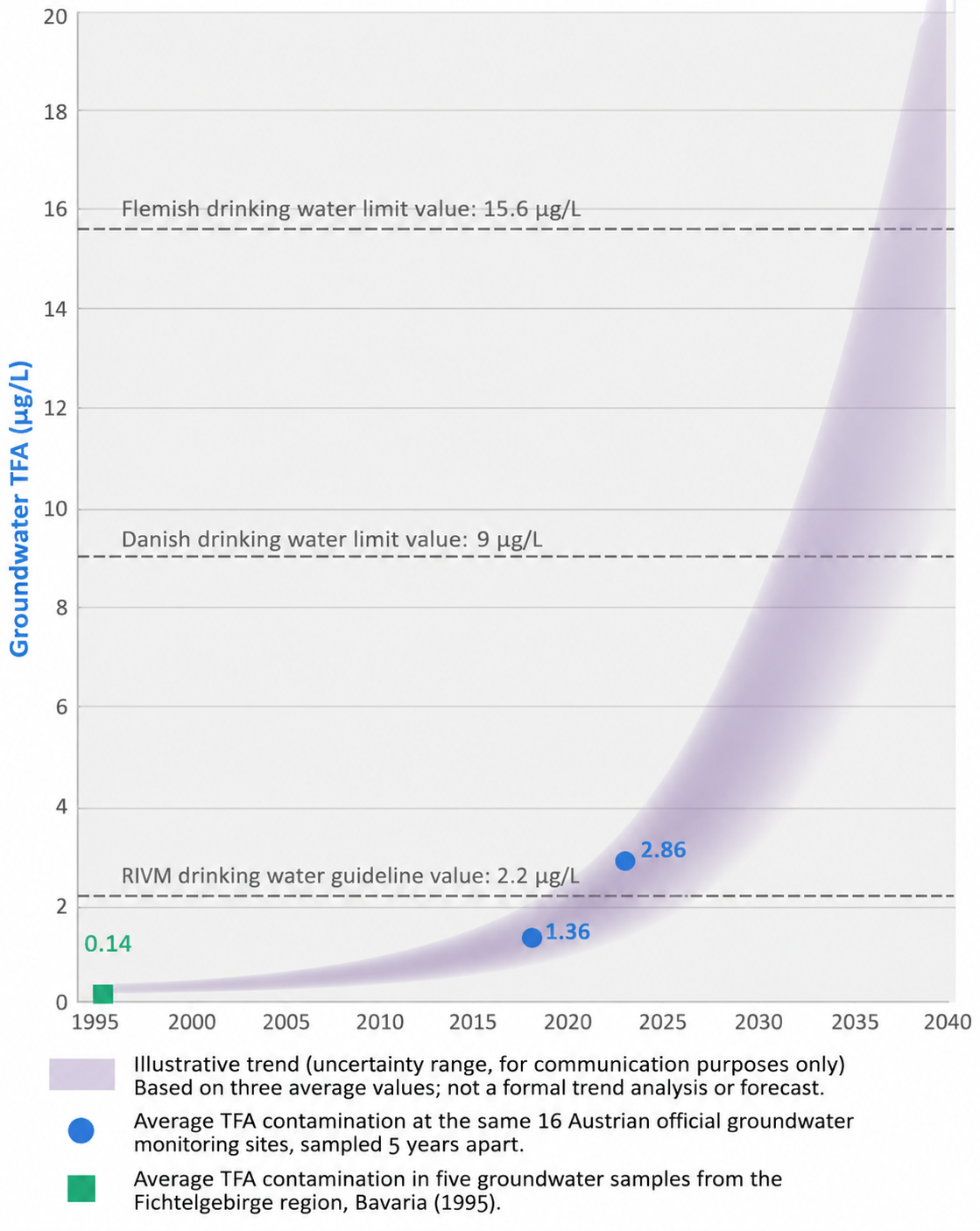
A new scientific analysis of official monitoring data shows a marked increase in TFA contamination in Austrian groundwater linked to agricultural activities. Concentrations of the “forever chemical” trifluoroacetic acid (TFA) increased at all 16 monitoring sites sampled twice over a period of around five years, from an average of 1.36 to 2.86 micrograms per litre. Not a single site showed stable or decreasing concentrations. This sends an alarm to the EU and all Member States to cut all sources of TFA into groundwater, starting with PFAS pesticides.
“These figures reveal not only a contamination problem, but one that is rapidly getting worse. It is precisely this combination of already high TFA concentrations and a continuing increase that makes the findings so concerning. We urgently need to stop this rise. One key measure is to phase out PFAS pesticides and TFA-forming fluorinated gases,” says Helmut Burtscher-Schaden, study author and environmental chemist at GLOBAL 2000.
The analysis by Helmut Burtscher-Schaden (GLOBAL 2000), Thilo Hofmann (University of Vienna), Angeliki Lysimachou (PAN Europe), Mattias Öberg (Karolinska Institutet) and Hans Peter Arp (Norwegian Geotechnical Institute / NTNU Trondheim) has been published as a joint scientific preprint. The underlying monitoring data were disclosed by the Austrian Ministry of Agriculture (BMLUK) following an environmental information request by GLOBAL 2000.
Increase in all federal states
In 2018/2019 and 2024, BMLUK analysed around 100 groundwater monitoring sites for TFA in each campaign, mostly at different locations. Sixteen sites, located in eight federal states, were sampled in both monitoring programmes. TFA concentrations did not remain stable or decrease at any of these sites; moreover, at one site, concentrations increased more than fourfold.
“The increase in groundwater TFA is particularly pronounced in Burgenland, Lower Austria and Upper Austria, as well as in parts of Styria,” says Burtscher-Schaden, who also compared the TFA results with nitrate levels and pesticide residues. Sites with high TFA concentrations also tended to show elevated nitrate levels and pesticide contamination. “The pattern points to a substantial contribution from agricultural use of PFAS pesticides to TFA contamination,” says Burtscher-Schaden.
Far above the EU limit and a ‘toxic to reproduction’ classification
An EU groundwater quality standard of 0.1 micrograms per litre applies to toxicologically relevant pesticide breakdown products. TFA is such a toxicologically relevant breakdown product. At the sites investigated in 2024, the mean TFA concentration was 2.4 micrograms per litre, which is 24 times this value.
The hazard classification of TFA has also become more stringent. In June 2026, the Risk Assessment Committee (RAC) of the European Chemicals Agency ECHA recommended that TFA be classified as toxic to reproduction, category 1B (may harm the developing foetus), and additionally as persistent, mobile and toxic (PMT) and very persistent and very mobile (vPvM) [1]. The European Commission should now follow this recommendation, which means TFA will be officially classified across the EU as toxic to reproduction. Later in July, the European Food Safety Authority EFSA lowered the acceptable daily intake (ADI) by more than 70 per cent to 0.014 mg/kg [2].
“What has been measured in Austria is more than a local finding: TFA is accumulating worldwide, and what is emitted today remains in the water cycle for generations to come. The key question is not only whether current concentrations are already harmful, but also what level of contamination we are leaving to future generations. If we wait until health-based guidance values are exceeded before taking action, we will have effectively already decided against any preventive action,” says Mattias Öberg, toxicologist at the Swedish Karolinska Institutet and co-author of the analysis.
What needs to happen now
PAN Europe is calling on the European Commission and all Member States to rapidly phase out PFAS pesticides that form TFA. The findings now available trigger concrete obligations under EU law.
“Under the EU rules, when toxicologically relevant pesticide breakdown products contaminate groundwater above 0.1 micrograms per litre, the authorisations of the pesticides concerned must be reviewed and withdrawn. The Austrian findings are a warning signal for the whole EU: other Member States should examine their own groundwater resources for similar trends and take action to cut emissions of TFA and its precursor substances, starting with PFAS pesticides. The European Commission must also take a stance - by phasing out all PFAS pesticides at EU level,” says Angeliki Lysimachou, Senior Environmental Toxicologist at PAN Europe.
An open question
BMLUK published both monitoring campaigns in its own water quality reports. However, the two datasets were not compared – leaving the increase invisible in the official reports.
“Policy-makers and authorities have a responsibility to protect human health and our water resources from permanent chemical contamination. That responsibility now means taking PFAS pesticides that emit TFA off the market and supporting farmers in switching to alternatives. The Ministry of Agriculture must create the necessary framework, while the Chamber of Agriculture should support farmers in making this transition. The fact that this marked increase in TFA contamination does not appear in the official reports requires an explanation. We will investigate this question and publish further information in the coming days,” says Alexandra Strickner, Executive Director for Policy at GLOBAL 2000.
Facts:
- TFA is an extremely mobile PFAS. It hardly degrades in the environment and is difficult to remove using conventional drinking-water treatment methods. It is formed, among other sources, through the degradation of fluorinated pesticides, refrigerants, pharmaceuticals and industrial chemicals.
- The scale of TFA contamination in groundwater is unprecedented: In comparison, at 104 monitoring sites, the mean TFA concentration was 264 times higher than the mean sum of the other 27 PFAS measured at the same sites in 2022.
- Comparing the two complete monitoring campaigns, average TFA contamination in 2024 was 2.42 micrograms per litre, more than three times the 0.78 micrograms per litre measured in 2018/2019. However, because the campaigns sampled mostly different sites selected specifically because contamination was expected, this comparison does not provide evidence of a temporal trend. The more than twofold increase observed at the 16 sites where sampling was repeated provides robust evidence for the time trend.
Further information: Factsheet · Preprint and underlying data · High-resolution graphics · Federal-state analyses available on request
Contact: Dr Angeliki Lysimachou, Head of Science and Policy, angeliki [at] pan-europe.info, +32 496 392930