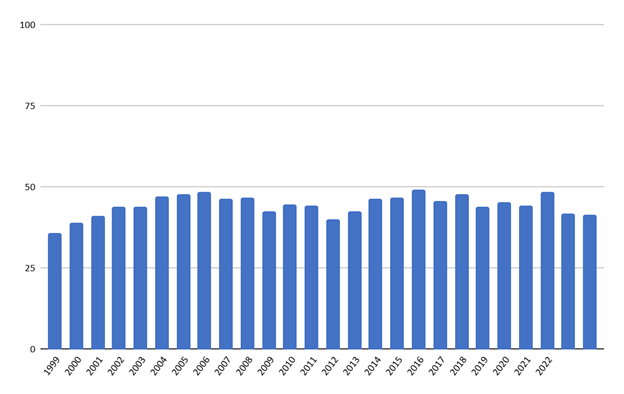
A new report by the European Food Safety Authority (EFSA) [1] reveals that 41.6% of fruit and vegetables sold in the EU contain pesticide residues, with 25.5% containing more than one residue. This means that one out of four consumed fruit and vegetables exposes consumers to pesticide cocktails that are not assessed by EFSA, despite its legal obligation to do so. Worryingly, most of the identified residues are neurotoxicants, putting our children's brain development at risk.
"These results remain concerning as mounting scientific evidence shows that exposure to pesticide residues via food are linked to higher risks of developing chronic diseases such as cancer, and can lead to infertility," remarks Martin Dermine, Executive Director at PAN Europe.
Oranges, table grapes, strawberries and apples remain the most contaminated food items, according to EFSA. This supports the findings of a recent report by PAN Europe [2], which tested apples in 13 European countries and discovered that 85% of the samples contained multiple residues.
Salomé Roynel, Policy Officer, comments: "Consumers are exposed on a daily basis to cocktails of endocrine disruptors, PFAS pesticides or neurotoxicants whose combined health effects are not assessed. This is due to EFSA’s unacceptable failure to deliver on its legal obligation to develop a methodology to assess pesticide cocktails since 2005."
PAN Europe advocates for the immediate application of a Mixture Assessment Factor (MAF) [3] to reduce allowable exposure limits and better protect public health against exposure to pesticide cocktails.
PAN Europe further regrets the lack of transparency in EFSA's communication, which provides, in their general communication, only general statistics on the level of contamination, and fails to highlight that the most frequently found pesticides are the most hazardous, a fact which is instead buried within their database.
The EFSA data shows that residues of EU-banned pesticides, such as Chlorpyrifos or Imidacloprid, two neurotoxicants toxic for foetal brain development, are among the most frequently identified residues, in particular those exceeding the legal limit.
"The most hazardous pesticides, banned to protect health and the environment, are coming back to our plates through imported food, and they are those more frequently breaching legal limits. This is a toxic double standard that must end, as promised in the Vision for Agriculture and Food,” adds Salomé Roynel.
"The most frequently found substances are neurotoxic pesticides, such as Chlorpyrifos (despite its ban), pyrethroids or neonicotinoids, all of them harmful to the development of children's brains. We highly recommend that parents provide only organic food to their children, particularly for the most contaminated fruit and vegetables," advises Martin Dermine.
Proportion of food sold in the EU containing residues of pesticides
Contact: PAN Europe, Salomé Roynel, Policy Officer, salome [at] pan-europe.info, +32 (0) 2 318 62 55
Notes:
[1] Pesticide residues in food: latest data released | EFSA
[2] Pesticide cocktails, PFAS and neurotoxins in most European apples | PAN Europe
