
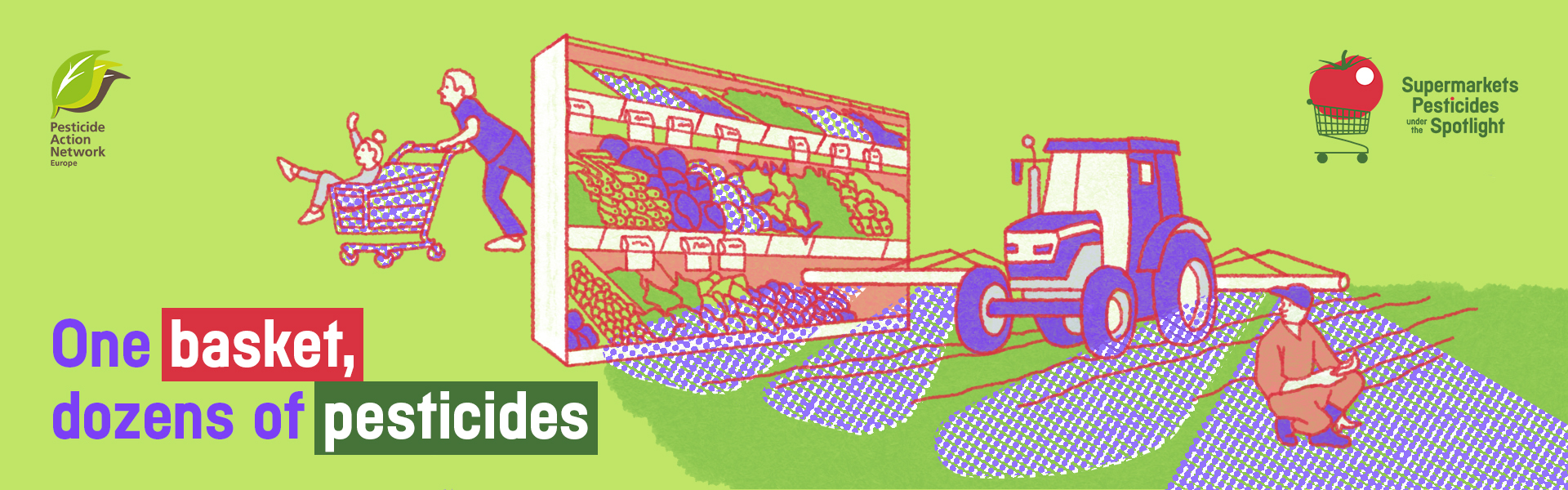
Supermarkets: a decisive lever to reduce pesticide use in Europe
Europe’s largest supermarket chains have enormous influence over what ends up on our plates.
Today, around 70% of all food sold in the EU passes through supermarkets, giving the retail sector immense power over agricultural practices and consumer choices.
Yet the failure of EU institutions to adopt legally binding pesticide‑reduction targets shows that political promises alone are not enough. Achieving real, systemic change requires activating other powerful levers.
As major players in the food system, supermarkets share responsibility for the environmental and health impacts linked to pesticide use. But they also have the power to accelerate the transition away from pesticide use: their sourcing decisions directly shape what farmers grow and how they grow it.
The campaign “Supermarkets: Pesticides under the spotlight” aims at
- Raising awareness of the retail sector’s responsibility in building sustainable food systems
- Encouraging supermarkets to promote real Integrated Pest Management (IPM) and agricultural methods based on agroecology, while supporting farmers’ livelihoods
- Driving systemic change to reduce Europe’s dependency on pesticides`
This will be achieved by creating a ranking of the supermarkets based mainly on their pesticide-reduction policies and practices.
This campaign is led by PAN Europe, together with its national member organisations in four countries:
- Belgium: Nature & Progrès Belgique
- France: Générations Futures
- Netherlands: PAN Netherlands
- Germany: PAN Germany
Inspired by PAN UK's campaign
PAN UK has demonstrated that putting retailers under the spotlight works. By producing supermarket ranking, making individual recommendations, and engaging directly with retail chains, PAN UK has successfully pushed several major British supermarkets to adopt stronger pesticide reduction policies, develop supplier guidance on hazardous substances, and publicly commit to supporting farmer transitions away from pesticide dependency.
Methodology
Our assessment is based on:
- a detailed questionnaire sent to supermarkets,
- publicly available online information,
- complementary pesticide residue testing on selected products.
Supermarket ranking will focus on an evaluation of each supermarket across five criteria, each scored from 0 (no action) to 4 (leading practice). Scores reflect policies, implementation, transparency, residue testing, and more.
The five evaluation criteria are:
- Restrictions on Highly Hazardous Pesticides (HHPs) and other harmful substances in food production
- Residue standards & monitoring systems
- Support for farmers & promotion of alternatives
- Organic product offer
- Transparency
For each criterion, supermarkets will be assessed against:
- PAN Europe’s and members’ ideal vision,
- what is realistically achievable in the sector today,
- how each retailer compares to other supermarkets,
- and the overall direction of the retail sector.
Direct engagement with retailers
We engage constructively with supermarket chains to encourage them to adopt and publish ambitious pesticide policies, develop clear reduction roadmaps for their suppliers and provide concrete support for farmers transitioning to safer practices.
Campaign Timeline
Preparations for this campaign started in 2025, and the first ranking and report will be published end of November 2026. Residue testing and the supermarket ranking will be updated annually to track whether retailers are making real progress or falling behind on their commitments.