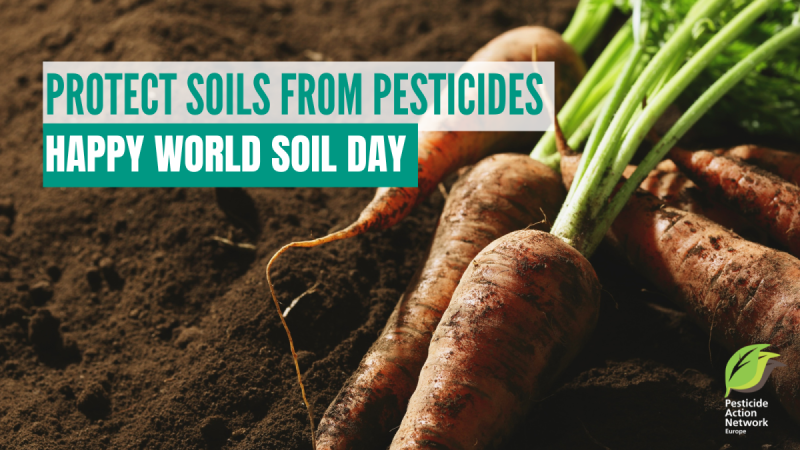
Today is World Soil Day. That is important, given the fact that soils have been, for a long time, largely overlooked. The official World Water Day has been celebrated since 1993. The first official World Soil Day was only held in 2014, more than 20 years later. This while soils are the foundation of our subsistence, and host an incredible amount of biodiversity and essential functions. However, up to 70% of EU soils are unhealthy, and progressively degraded by many factors. Pesticides are one of the major causes: they kill soil life and pollute our soils, water, crops, air, wider environment and food. We need to urgently protect our soils from pesticides. Let’s celebrate soil life today, and all farmers and other land managers minimising and phasing out pesticides.
Unearthening soil life and functions
Healthy soils provide a wide range of ecosystem functions, such as biodiversity, plant and crop growth, natural pest control, pollination, decomposition, nutrient cycling, carbon storage, water infiltration, filtering and storage, and erosion management [1]. Healthy soils are the basis of healthy, future-proof food production. Most of what we eat, drink, wear, use and live in originates from soil.
For a long time, soils have been viewed by many as a ‘dead substrate’, which cannot be further from reality. The essential foundation of healthy soils are soil organisms. Soils are our most biodiverse ecosystem: they host an incredible and fascinating amount of life: at least 59% of earth’s species, 90% of fungi, 85% of plants and 50% of bacteria live in soils [2]. One gram of soil can hold billions of organisms. Many species spend part of their life cycle in soils. For example, about 70% of bee species nest in soils [3]. Soil organisms form complex interactions to support healthy soil functioning. For example, in their rootzone, ‘the rhizosphere’, plants interact with bacteria, fungi and other organisms to foster nutrient availability and uptake, plant growth, and to fight off pathogens. Organisms surrounding the plant function in a way as an ‘external gut’ to the plant, forming an ecological unit with it, called ‘holobiont’ [4].
Pesticides are widespread in our soils
Alarmingly, soils have been deteriorating fast. Up to 70% of EU soils are unhealthy. The EU Soil Observatory dashboard indicates that 62% of all soils and 89% of agricultural soils show signs of critical loss of functions [5]. Soil pollution, droughts, floods, erosion, loss of structure and land take are important factors [6]. Pesticides dramatically impact soils. They not only pollute soils, groundwater, surface water, crops, food, air and the wider environment, they also wipe out soil biodiversity.
Among more within the LUCAS soil monitoring framework and the EU Sprint project, soil monitoring campaigns have been carried out. Pesticide mixtures in soils are shown the rule rather than the exception. In 83%-97% of soil samples, at least one pesticide was found, while 58%-88% of samples contained pesticide mixtures [7]. Many of the found pesticides are also ‘toxic legacy pesticides’: pesticides which have been banned for a long time, but prevail in our soils due to their persistence. An example is the insecticide DDT. Although banned for decades due to its disastrous effects, the substance still widely resides in our environment. DDT is infamous: written about extensively in Rachel Carson’s Silent Spring, sung about by Joni Mitchell (‘put away that DDT now..’) and taken up in the top 50 list of ‘worst inventions’ by Time Magazine. Instead of lessons being drawn, harmful and persistent substances are still sprayed on our soils daily, including PFAS pesticides. PFAS pesticides and their problematic metabolite TFA are widely present in our soils, water bodies and drinking water [8]. This dramatic failure to act and stop harmful pollution at its source can impact generations to come.
Fundamental shortcomings in risk assessment and regulatory framework undermine soil health
Sprint research has shown that the Predicted Environmental Concentrations (PEC values), which are calculated based on pesticide application data, often do not accurately reflect field concentrations [9]. PEC values are calculated for main crops in view of risk assessment and EU dossiers for active substance approval. They are based on recommended application rates and worst-case scenarios. In 26.1% the calculated PECs underestimated the measured environmental concentrations. The persistence of substances is found to be regularly underestimated. Evidently, when PECs do not correctly reflect field concentrations, this poses important concerns for risk assessment.
This comes on top of the various fundamental shortcomings in risk assessment: only a very limited set of (soil) organisms is tested, mixture, cumulative and synergistic effects, and long-term exposure to landscape-level pesticide pollution are not taken into account [10]. The guidance documents defining the protection standards and methodology for pesticide impacts provide free passes for eradicating soil life, as shown for example in our report ‘License to Kill’, on the EU guideline on non-target arthropods [11]. The guidelines allow killing of as much as 50% of the population with the spraying of a single pesticide, or even up to 100% of mortality, incorrectly assuming ‘recovery’ will be possible.
Pesticides run soil life into the ground, threatening not only global biodiversity but also human health
These dramatic shortcomings in risk assessment and regulatory framework turn our soils into graveyards. Most of the detected pesticides in soils, and all types (insecticides, fungicides and herbicides), are harmful to soil organisms [12]. Extensive reviews on the impacts of pesticides on soil organisms show that “pesticides have significant detrimental effects on soil biodiversity, eroding a substantial part of global biodiversity and threatening ecosystem health” [13]. This is alarming, and should be an evident call for urgent and ambitious action. We have to protect soil biodiversity for its incredible value in itself, as well as to protect soils and its functions as the foundation of all life, including our subsistence.
Pesticide pollution of soils, leading to pollution of water resources, food, and pollution of our wider environment, has also detrimental impacts on human health [14]. Through food and water intake, inhalation, ingestion or dermal exposure, citizens are exposed to pesticides. Moreover, healthy soil microbiomes are essential for ecosystem and human health. Research is unravelling important links between the soil microbiome and gut microbiome, and links with health conditions, for example, neurological diseases [15]. Human microbiomes exchange beneficial microbes with the environment. Studies show the need for children to play in and with healthy soil: close contact with healthy soils leads to a stronger immune system, better protection against autoimmune diseases, and lower amounts of pathogenic bacteria in the gut microbiome associated with inflammatory bowel diseases, colitis, sepsis and botulism [16]. At the same time, children are particularly vulnerable to the harmful effects of pesticides, which makes the need to protect soils even more pressing.
A first EU Soil Directive as common ground
Many scientists have called for the urgent need to protect and restore soils, and for an EU-level policy framework to efficiently do that [17]. Recently, EU policy makers found common ground on the EU's first-ever law on soil: ‘The Soil Monitoring and Resilience Directive’. A historic and important first step [18]. The Directive will, among other things:
- Increase comparable soil monitoring and soil health assessment data for common soil descriptors. This will include increased monitoring of pollutants such as pesticides, PFAS and other emerging contaminants.
- Support capacity building and services for land managers, including access to impartial and independent science-based advice, training activities, as well as operational resources, to improve soil health and soil resilience.
- Contribute to addressing important knowledge gaps.
- Support member states in the form of common tools and methodologies provided by the Commission, and through facilitated exchange of best practices.
- Deliver soil health assessments, which should trigger the implementation of needed measures and practices. Ambitious implementation will hopefully increase coordinated action to reverse soil degradation and restore soils, also through cooperation among member states.
- Ensure the identification and management of contaminated sites, and the mitigation of land take.
However, the text is heavily flawed and far from as ambitious as urgently needed [19]. It was stripped of core provisions on sustainable soil management. The monitoring requirements, among more on soil pollution and biodiversity, lack robustness and ambition. It will be key that national policy makers realise that, to move forward and ensure a healthy, thriving future, we need to protect what lies beneath. Soil pollution and other degradation should not only be thoroughly monitored, but also urgently, ambitiously reversed, to effectively protect and restore our soils.
Soil research projects provide fertile soil to grow ambitious soil policies and management
In the framework of the EU Mission ‘A Soil Deal for Europe’ [20], and beyond the Soil Mission, multiple valuable projects on soils are ongoing, focusing on better soil monitoring and assessment, sustainable soil management practices, soil restoration and increasing soil awareness and knowledge across society. PAN Europe is a partner in the Soils for Europe SOLO project [21], which aims to identify key knowledge gaps on soils, related to the different Soil Mission Objectives. PAN Europe is the co-coordinator of the Think Tank on Soil Pollution and Restoration, which looks specifically at key knowledge gaps related to soil pollution and needed actions to address them. Provisional outcomes are assembled in the ‘Outlook on the knowledge gaps to soil pollution and restoration’ [22]. Recently, the provisional knowledge gap assessments of the different SOLO Think Tanks have been published in the “Outlook 2025 - Soil Health R&I Knowledge Gaps” [23]. Further work will continue to build on this, aiming to develop a synthesis roadmap for research and innovation, to foster protection and sustainable management of EU soils. Close cooperation of science and policy, and uptake of the findings and outcomes of soil research (projects) in policy and soil management decisions, will be key to ensuring robust implementation of the Soil Monitoring and Resilience Directive, and effective soil protection and restoration.
Protect our soils, overall ecosystems and health from pesticides
Evidently, a full, much better implementation of pesticide legislation is absolutely key to protecting our soils. The far-reaching, fundamental shortcomings in pesticide risk assessment need to be addressed to ensure robust protection of soil biodiversity, overall biodiversity and human health. The gaps in the regulatory framework on the authorisation of pesticides need to be closed. Urgent priorities include: a phase out of candidates for substitution and PFAS substances, obligatory testing for neurotoxicity, robust assessment of pesticide metabolites and co-formulants, assessment of cumulative and synergistic effects, and a full, up-to-date literature review when authorising active substances (EU level) or pesticides (national level) [24].
At the same time, pesticide use and risk have to be greatly reduced. Restoring soil health is the basis of a future-proof cropping system. That is impossible without minimising or phasing out pesticides. Pesticide-free practices should be the default [25], with pesticides, with the lowest possible risk, only used as a very last resort. Full implementation of Integrated Pest Management (IPM), mandatory in the EU under the Sustainable Use of Pesticides Directive since 2014, is long overdue. IPM requires committing fully to preventative measures, such as crop diversification and crop rotation. An important recommendation of the EU Agrowise project, which focuses on pathways to better IPM implementation, is that plant protection should be based on ‘active prophylaxis’: “every crop management decision - management of pest reservoirs, rotation, sowing - must be a conscious contribution to crop protection through reduction of pest pressure” [26].
Many farmers are leading the way
Many farmers throughout Europe are minimising or completely phasing out pesticides, fostering living and thriving soils. Our recent report, ‘Farming beyond pesticides - success stories from the field’ [27], shows different cropping systems across Europe phasing out pesticides. While there is high diversity in systems and practices, they all have a common denominator: they all place healthy soils at the core of their system and practices. We cannot produce food on sterilised, dead substrates.
While soils are less visible to our eyes than the rest of our environment, they are the foundation of our livelihoods. Joni Mitchell sang ‘ you don't know what you've got 'til it's gone’. We can hopefully avoid that fate when it comes to soil life and health. Recent increased attention, awareness and understanding of soils and its enormous complexity and biodiversity, and many passionate researchers, farmers, other land managers, policy makers and citizens, can pave (or rather unpave:)) the way to living, healthy soils.
Notes:
[1] Arias-Navarro and Bartiz - European Environment Agency (2024) - The State of Soils in Europe
[2] Anthony et al. (2023) - Enumerating soil biodiversity
[3] Digging below the surface: Hidden risks for ground-nesting bees
[4] Ramírze-Puebla et al. (2013) - Gut and Root Microbiota Commonalities, Mendes and Raaijmakers (2015) - Cross-kingdom similarities in microbiome functions, Berg and Koskella (2018) - Nutrient- and Dose-Dependent Microbiome-Mediated Protection against a Plant Pathogen, PAN Europe (2023) - Beneath the orange fields: Impact of Glyphosate on soil organisms, Monbiot (2022) - Regenesis: Feeding the World Without Devouring the Planet
[5] Joint Research Center (2024) - EUSO Soil Degradation Dashboard
[6] Arias-Navarro and Bartiz - European Environment Agency (2024) - The State of Soils in Europe, Vieira et al. (2024) - Soil pollution in the European Union – An outlook
[7] Silva et al. (2019. Pesticide residues in European agricultural soils – A hidden reality unfolded, Silva et al. (2023). Pesticide residues with hazard classifications relevant to non-target species including humans are omnipresent in the environment and farmer residences. Knuth et al. (2024). Pesticide Residues in Organic and Conventional Agricultural Soils across Europe: Measured and Predicted Concentrations
[8] PAN Europe - Ban PFAS pesticides and TFA, PAN Europe (2025) - Unseen and Unregulated: TFA, the ‘forever chemical’ in Europe’s Cereals
[9] Knuth et al. (2024). Pesticide Residues in Organic and Conventional Agricultural Soils across Europe: Measured and Predicted Concentration
[10] SPRINT magazine: final key messages, Brühl et al. (2024). Widespread contamination of soils and vegetation with current use pesticide residues along altitudinal gradients in a European Alpine valley, Honert et al. (2025). Exposure of insects to current use pesticide residues in soil and vegetation along spatial and temporal distribution in agricultural sites, Mauser et al. (2025). Current-use pesticides in vegetation, topsoil and water reveal contaminated landscapes of the Upper Rhine Valley, Germany, Brühl C, Zaller J (2019) Biodiversity Decline as a Consequence of an Inappropriate Environmental Risk Assessment of Pesticides
[11] PAN Europe (2024) - Licence to Kill - an EU guideline with far-reaching consequences
[12] Beaumelle et al. (2023). Pesticide effects on soil fauna communities - A meta-analysis. Gunstone et al. (2021). Pesticides and Soil Invertebrates: A Hazard Assessment, Silva et al. (2023). Pesticide residues with hazard classifications relevant to non-target species including humans are omnipresent in the environment and farmer residences, PAN Europe (2023). Beneath the orange fields: Impact of Glyphosate on soil organisms
[13] Beaumelle et al. (2023). Pesticide effects on soil fauna communities - A meta-analysis
[14] Inserm (2021). Collective Expert Review on the Health Effects of Pesticides, EEA, 2023: How pesticides impact human health and ecosystems in Europe, Münzel et al. (2024) - Soil and water pollution and cardiovascular disease
[15] Matsuzaki et al. (2023) - Pesticide exposure and the microbiota-gut-brain axis, Ma et al. (2025) - The soil-plant-human gut microbiome axis into perspective, Sheng Lo et al. (2024) - Microbiota–gut–brain axis and its therapeutic applications in neurodegenerative diseases
[16] The Guardian (2025). How a radical experiment to bring a forest into a preschool transformed children’s health
[17] Scientists and Soil Experts support the Soil Law, https://soils4europe.eu/news/statement-support-soil-monitoring-law
[18] Text Soil Monitoring and Resilience Directive, Summary of content of Soil Monitoring and Resilience Directive
[19] A weak deal for Europe’s soils, EurEau (2023) EurEau reaction to the Commission's Soil Monitoring Law, https://, https://soils4europe.eu/news/statement-support-soil-monitoring-law, EEB (2023) Assessment of the European Commission proposal for a Soil Monitoring Law.
[20] EU Mission: A Soil Deal for Europe
[22] SOLO Soils for Europe “Outlook on the knowledge gaps to soil pollution and restoration”
[23] SOLO Soils for Europe “Outlook 2025: Soil Health R&I Knowledge Gaps”
[24] Letter: Oppose to pesticides' deregulation in the Omnibus on food and feed safety - More protection is needed, not less, Letter: Call to strengthen implementation of EU Pesticide Law to protect health and the environment
[25] SPRINT magazine: final key messages
[26] https://eng-agrowise.hub.inrae.fr/ , policy recommendations Agrowise
[27] Farming beyond pesticides: success stories from the field
